Albert Einstein
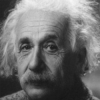
Albert Einstein
Albert Einstein; 14 March 1879 – 18 April 1955) was a German-born theoretical physicist. He developed the general theory of relativity, one of the two pillars of modern physics.:274 Einstein's work is also known for its influence on the philosophy of science. Einstein is best known in popular culture for his mass–energy equivalence formula E = mc2. He received the 1921 Nobel Prize in Physics for his "services to theoretical physics", in particular his discovery of the law of the photoelectric...
NationalityGerman
ProfessionScientist
Date of Birth14 March 1879
CityUlm, Germany
CountryGermany
I have made no secret, either privately or publicly, of any sense of outrage over officially enforced military and war service. I regard it as a duty of conscience to fight against such barbarous enslavement of the individual with every means available.
Democracy, taken in its narrower, purely political, sense, suffers from the fact that those in economic and political power possess the means for molding public opinion to serve their own class interests. The democratic form of government in itself does not automatically solve problems; it offers, however, a useful framework for their solution. Everything depends ultimately on the political and moral qualities of the citizenry.
Intelligence makes clear to us the interrelationship of means and ends. But mere thinking cannot give us a sense of the ultimate and fundamental ends. To make clear these fundamental ends and valuations and to set them fast in the emotional life of the individual, seems to me precisely the most important function which religion has to form in the social life of man.
Only a life lived for others is a life worthwhile.
Physics is essentially an intuitive and concrete science. Mathematics is only a means for expressing the laws that govern phenomena.
Science has gone a long way toward helping man to free himself from the burden of hard labor; yet, science itself is not a liberator. It creates means, not goals. It is up to men to utilize those means to achieve reasonable goals.
What is the meaning of human life, or, for that matter, of the life of any creature? To know the answer to this question means to be religious. You ask: Does it make any sense, then, to pose this question? I answer: The man who regards his fellow creatures as meaningless is not merely unhappy but hardly fit for life.
I agree with your remark about loving your enemy as far as actions are concerned. But for me the cognitive basis is the trust in an unrestricted causality. 'I cannot hate him, because he must do what he does.' That means for me more Spinoza than the prophets.
Science is the century-old endeavor to bring together by means of systematic thought the perceptible phenomena of this world into as thorough-going an association as possible.
There is not the slightest indication that nuclear energy will ever be obtainable. It would mean that the atom would have to be shattered at will.
All meaningful and lasting change starts first in your imagination and then works its way out. Imagination is more important than knowledge.
Learning is the beginning of wealth. Searching and learning is where the miracle process all begins. The great breakthrough in your life comes when you realize it that you can learn anything you need to learn to accomplish any goal that you set for yourself. This means there are no limits on what you can be, have or do.
The religion of the future will be a cosmic religion. It should transcend a personal God and avoid dogmas and theology. Covering both the natural and the spiritual, it should be based on a religious sense arising from the experience of all things, natural and spiritual, as a meaningful unity. Buddhism answers this description.
In the beginning (if there was such a thing), God created Newton's laws of motion together with the necessary masses and forces. This is all; everything beyond this follows from the development of appropriate mathematical methods by means of deduction.