Isaac Newton
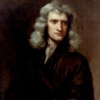
Isaac Newton
Sir Isaac Newton PRSwas an English physicist and mathematicianwho is widely recognised as one of the most influential scientists of all time and a key figure in the scientific revolution. His book Philosophiæ Naturalis Principia Mathematica, first published in 1687, laid the foundations for classical mechanics. Newton made seminal contributions to optics, and he shares credit with Gottfried Wilhelm Leibniz for the development of calculus...
NationalityEnglish
ProfessionScientist
Date of Birth4 January 1643
CityWoolsthorpe, England
I was like a boy playing on the sea-shore, and diverting myself now and then finding a smoother pebble or a prettier shell than ordinary, whilst the great ocean of truth lay all undiscovered before me.
I can see so far because I stood on the shoulders of giants.
No old Men (excepting Dr. Wallis) love Mathematicks.
...from the same principles, I now demonstrate the frame of the System of the World.
The latest authors, like the most ancient, strove to subordinate the phenomena of nature to the laws of mathematics.
I feign no hypotheses.
Absolute, true and mathematical time, of itself, and from its own nature flows equably without relation to anything external.
God created everything by number, weight and measure.
Truth is ever to be found in the simplicity, and not in the multiplicity and confusion of things.
If I have seen farther than others, it is because I was standing on the shoulders of giants.
The word 'God' usually signifies 'Lord', but every lord is not a God. It is the dominion of a spiritual being which constitutes a God: a true, supreme, or imaginary dominion makes a true, supreme, or imaginary God.
The smaller the planets are, they are, other things being equal, of so much the greater density; for so the powers of gravity on their several surfaces come nearer to equality. They are likewise, other things being equal, of the greater density, as they are nearer to the sun.
The same thing is to be understood of all bodies, revolved in any orbits. They all endeavour to recede from the centres of their orbits, and were it not for the opposition of a contrary force which restrains them to and detains them in their orbits, which I therefore call Centripetal, would fly off in right lines with a uniform motion.
The same law takes place in a system, consisting of many bodies, as in one single body, with regard to their persevering in their state of motion or of rest. For the progressive motion, whether of one single body or of a whole system of bodies, is always to be estimated from the motion of the center of gravity.