Jose Ortega y Gasset
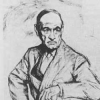
Jose Ortega y Gasset
José Ortega y Gassetwas a Spanish liberal philosopher, and essayist. He worked during the first half of the 20th century, while Spain oscillated between monarchy, republicanism, and dictatorship. His philosophy has been characterized as a "philosophy of life" that "comprised a long-hidden beginning in a pragmatist metaphysics inspired by William James, and with a general method from a realist phenomenology imitating Edmund Husserl, which served both his proto-existentialism and his realist historicism, which has been compared to both Wilhelm Dilthey...
NationalitySpanish
ProfessionPhilosopher
Date of Birth9 May 1883
CountrySpain
Youth does not require reasons for living, it only needs pretexts.
By speaking, by thinking, we undertake to clarify things, and that forces us to exacerbate them, dislocate them, schematize them. Every concept is in itself an exaggeration.
The poet begins where the man ends. The man's lot is to live his human life, the poet's to invent what is nonexistent.
We have need of history in its entirety, not to fall back into it, but to see if we can escape from it.
Human vitality is so exuberant that in the sorriest desert it still finds a pretext for glowing and trembling.
The history of the Roman Empire is also the history of the uprising of the Empire of the Masses, who absorb and annul the directing minorities and put themselves in their place. Then, also, is produced the phenomenon of agglomeration, of "the full." For that reason, as Spengler has very well observed, it was necessary, just as in our day, to construct enormous buildings. The epoch of the masses is the epoch of the colossal.
I do not deny that there may be other well-founded causes for the hatred which various classes feel toward politicians, but the main one seems to me that politicians are symbols of the fact that every class must take every other class into account.
The person portrayed and the portrait are two entirely different things.
The hero's will is not that of his ancestors nor of his society, but his own. This will to be oneself is heroism.
The well being of democracies regardless of their type and status is dependent on one small technical detail: The right to vote. Everything else is secondary.
There is no doubt; even a rejection can be the shadow of a caress”.
In their choice of lovers both the male and the female reveal their essential nature. The type of human being we prefer reveals the contours of our heart. Love is an impulse which springs from the most profound depths of our beings, and upon reaching the visible surface of life carries with it an alluvium of shells and seaweed from the inner abyss. A skilled naturalist, by filing these materials, can reconstruct the oceanic depths from which they have been uprooted.
Were art to redeem man, it could do so only by saving him from the seriousness of life and restoring him to an unexpected boyishness. The symbol of art is seen again in the magic flute of the Great God Pan which makes the young goats frisk at the edge of the grove. All modern art begins to appear comprehensible and in a way great when it is interpreted as an attempt to instill youthfulness into an ancient world .
I think that the philosopher must, for his own purposes, carry methodological strictness to an extreme when he is investigating and pursuing his truths, but when he is ready to enunciate them and give them out, he ought to avoid the cynical skill with which some scientists, like a Hercules at the fair, amuse themselves by displaying to the public the biceps of their technique.