Mahatma Gandhi
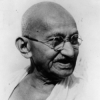
Mahatma Gandhi
Mohandas Karamchand Gandhi; 2 October 1869 – 30 January 1948) was the preeminent leader of the Indian independence movement in British-ruled India. Employing nonviolent civil disobedience, Gandhi led India to independence and inspired movements for civil rights and freedom across the world. The honorific Mahatma—applied to him first in 1914 in South Africa,—is now used worldwide. He is also called Bapuin India. In common parlance in India he is often called Gandhiji. He is unofficially called the Father of the Nation...
NationalityIndian
ProfessionCivil Rights Leader
Date of Birth2 October 1869
CityPortbandar, India
CountryIndia
A society grows great when old men plant trees whose shade they know they shall never sit in. An ounce of practice is worth more than tons of preaching.
It is a first class human tragedy that people of the earth who claim to believe in the message of Jesus, whom they describe as the Prince of Peace, show little of that belief in actual practice.
To practice nonviolence in mundane matters is to know its true value.
The practice of truth and nonviolence melted religious differences, and we learnt to see beauty in each religion.
Appreciation of nonviolence means patient research and still more patient and difficult practice.
Nonviolence is not an easy thing to understand, still less to practice, weak as we are.
Complete independence will be complete only to the extent of our approach in practice to truth and nonviolence.
Human life is a series of compromises, and it is not always easy to achieve in practice what one has found to be true in theory.
Ahimas is the attribute of the soul, and therefore, to be practiced by everybody in all affairs of life. If it cannot be practiced in all departments, it has no practical value.
We have to make truth and non-violence not matters for mere individual practice but for practice by groups and communities and nations. That at any rate is my dream. I shall live and die in trying to realize it. My faith helps me to discover new truths every day.
Ahimsa is the highest duty. Even if we cannot practice it in full, we must try to understand its spirit and refrain as far as is humanly possible from violence.
If one does not practice nonviolence in one's own personal relations with others and hopes to use it in bigger affairs, one is vastly mistaken.
A principle is a principle and in no case can it be watered down because of our incapacity to live it in practice. We have to strive to achieve it, and the striving should be conscious, deliberate and hard.
It is not that I do not get angry. I don't give vent to my anger. I cultivate the quality of patience as angerlessness, and generally speaking, I succeed. But I only control my anger when it comes. How I find it possible to control it would be a useless question, for it is a habit that everyone must cultivate and must succeed in forming by constant practice.