Marsilio Ficino
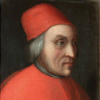
Marsilio Ficino
Marsilio Ficinowas an Italian scholar and Catholic priest who was one of the most influential humanist philosophers of the early Italian Renaissance. He was also an astrologer, a reviver of Neoplatonism in touch with every major academic thinker and writer of his day and the first translator of Plato's complete extant works into Latin. His Florentine Academy, an attempt to revive Plato's Academy, had enormous influence on the direction and tenor of the Italian Renaissance and the development of European...
NationalityItalian
ProfessionPhilosopher
Date of Birth19 October 1433
CountryItaly
Saturn seems to have impressed the seal of melancholy on me from the beginning.
A sturdy lad . . . who teams it, farms it . . . and always like a cat falls on his feet, is worth a hundred of these city dolls.
Who can wonder at the attractiveness... of the bar, for our ambitious young men, when the highest bribes of society are at the feet of the successful orator?
Laurel crowns cleave to deserts And power to him who power exerts; Hast not thy share? On winged feet, Lo! it rushes thee to meet; . . .
. . . if [writing] lift you from your feet with the great voice of eloquence, then the effect is to be wide, slow, permanent, over the minds of men; . . .
Law it is . . . which hears without ears, sees without eyes, moves without feet and seizes without hands.
What is odious but . . . people . . . who toast their feet on the register. . . .
[Nature said] The sea shall disjoin the people [of England] from others, and knit them to a fierce nationality. It shall give them markets on every side. Long time I will keep them on their feet, by poverty, border-wars . . . seafaring . . .
The abstractionist and the materialist thus mutually exasperating each other, and the scoffer expressing the worst of materialism, there arises a third party to occupy the middle ground between these two, the skeptic, namely. He finds both wrong by being in extremes. He labors to plant his feet, to be the beam of the balance.
Poetry being an attempt to express, not the common sense, - as the avoirdupois of the hero, or his structure in feet and inches, - but the beauty and soul in his aspect . . . runs into fable, personifies every fact. . . .
The fate of the poor shepherd, who, blinded and lost in the snow-storm, perishes in a drift within a few feet of his cottage door, is an emblem of the state of man.
Everyone believes that he abounds in wisdom, but is short of money.
The doctors of antiquity have affirmed that love is a passion that resembles a melancholy disease. The physician Rasis prescribed, therefore, in order to recover, coitus, fasting, drunkenness, and walking.
Wealth begins . . . in giving on all sides by tools and auxiliaries the greatest possible extension to our powers; as if it added feet and hands and eyes and blood. . . .