Michael Chertoff
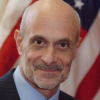
Michael Chertoff
Michael Chertoffis an American attorney who was the second United States Secretary of Homeland Security under Presidents George W. Bush andBarack Obama, and co-author of the USA PATRIOT Act. He previously served as a judge on the United States Court of Appeals for the Third Circuit, as a federal prosecutor, and as Assistant U.S. Attorney General. He succeeded Tom Ridge as United States Secretary of Homeland Security on February 15, 2005...
NationalityAmerican
ProfessionPublic Servant
Date of Birth28 November 1953
CountryUnited States of America
The fact of the matter is we have learned some lessons, we've listened to some of the critics, and where there is merit to some of those observations, we've incorporated changes to take account of those criticisms.
We may never know everybody who participated. But actually, I am encouraged by the fact that, as we have pulled together information that comes globally to us, we've filled in more and more pieces of the puzzle.
He's a believer in the fact that a judge has a limited role to play and has a responsibility to play the role in an honest fashion ? that you're not supposed to substitute your personal judgments for what the law is.
We are still in the emergency. People must take seriously the fact that we have enormous ongoing challenges which we have to address right now or we're going to continue to have serious problems,
So it's not meant to substitute for the trailers, but it's meant to recognize the fact that as we speak not everybody can or necessarily wants to get into trailers,
It would be enormously difficult if we were to attempt to control illegal immigration at the border without having some legal avenue to address the fact that there is a high demand for non-U.S. people to come in and perform certain kinds of jobs,
I knew I became more involved in operational matters than I would normally expect to be or want to be, given the fact that I had a battlefield commander on the ground, ... I am not a hurricane expert. I've got to rely on people to execute the details of the plan.
I'm kind of amazed you can write a report in which you reach your conclusions before you actually speak to the people who were involved in the decision-making process. It's kind of jumping to conclusions before the facts were gathered.
It was midday Tuesday that I became aware of the fact that there was no possibility of plugging the gap and that essentially the lake was going to start to drain into the city. I think that second catastrophe really caught everybody by surprise,
These are not people who are larger than life. They took advantage of the fact that something that was unthinkable on September 10 became, unfortunately, all too thinkable on September 11.
I think we're going to be ready when it does hit land,
I think we have discovered over the last few days that with all the tremendous effort using the existing resources and the traditional frameworks of the National Guard, the unusual set of challenges of conducting a massive evacuation in the context of a still dangerous flood requires us to basically break the traditional model and create a new model -- one for what you might call kind of an ultracatastrophe,
I think we need to prepare the country for what's coming, ... What's going to happen when we de-water and remove the water from New Orleans is we're going to uncover people who died, maybe hiding in houses, got caught by the flood, people whose remains are going to be found in the streets. . . . It is going to be about as ugly of a scene as I think you can imagine.
I think that that predication unhappily turned out to be correct and one of the things I said was we're racing the clock. Unfortunately, the hurricane beat us,