Michael Chertoff
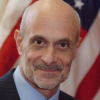
Michael Chertoff
Michael Chertoffis an American attorney who was the second United States Secretary of Homeland Security under Presidents George W. Bush andBarack Obama, and co-author of the USA PATRIOT Act. He previously served as a judge on the United States Court of Appeals for the Third Circuit, as a federal prosecutor, and as Assistant U.S. Attorney General. He succeeded Tom Ridge as United States Secretary of Homeland Security on February 15, 2005...
NationalityAmerican
ProfessionPublic Servant
Date of Birth28 November 1953
CountryUnited States of America
People have got to take some responsibility for preparing themselves, ... That means you get yourself three days' worth of food, three days' worth of water; you get yourself flashlights, batteries, either a hand-crank radio or a battery-powered radio, a first-aid kit precisely because you know it's going to take 48 to 72 hours to be able to fully service everyone.
He's a believer in the fact that a judge has a limited role to play and has a responsibility to play the role in an honest fashion ? that you're not supposed to substitute your personal judgments for what the law is.
The way that emergency operations act under the law is the responsibility and the power, the authority, to order an evacuation rests with state and local officials. The federal government comes in and supports those officials.
We now know people need gas during emergencies and they have a responsibility - those people who run stations and ultimately those people who provide the fuel - have responsibility to hold up their end when a crisis comes.
It's important to allow the new people who have the responsibility ... to have access to the information we need to do better, ... We don't want to sacrifice the real ability to get a full picture of Mike's experiences; we don't want to sacrifice that ability simply in order to make an image point.
The world is not going to stop moving because we are very focused on Katrina. Part of the responsibility of the Department of Homeland Security is to deal with all hazards, everything that's out there, and to continue to be able to keep our eye on everything that may happen in the future,
I think we're going to be ready when it does hit land,
I think we have discovered over the last few days that with all the tremendous effort using the existing resources and the traditional frameworks of the National Guard, the unusual set of challenges of conducting a massive evacuation in the context of a still dangerous flood requires us to basically break the traditional model and create a new model -- one for what you might call kind of an ultracatastrophe,
I think we need to prepare the country for what's coming, ... What's going to happen when we de-water and remove the water from New Orleans is we're going to uncover people who died, maybe hiding in houses, got caught by the flood, people whose remains are going to be found in the streets. . . . It is going to be about as ugly of a scene as I think you can imagine.
I think that that predication unhappily turned out to be correct and one of the things I said was we're racing the clock. Unfortunately, the hurricane beat us,
I think there's a strong argument that it ought not to be located in downtown Washington because of the desire to have some distance, you know, between ourselves and some other buildings,
last summer FEMA, who reports to you, and the LSU Hurricane Center, and local and state officials did a simulated Hurricane Pam in which the levees broke. ... Thousands drowned.
We can't be in the position any longer where we are paying the burden and bearing the burden for countries that won't cooperate with us and take their own citizens back.
We've got the adequate personnel now who are able to make sure that we have a comprehensive evacuation effort.