Pope Paul VI
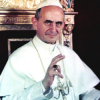
Pope Paul VI
Pope Paul VI, born Giovanni Battista Enrico Antonio Maria Montini, reigned as Pope from 21 June 1963 to his death in 1978. Succeeding Pope John XXIII, he continued the Second Vatican Council which he closed in 1965, implementing its numerous reforms, and fostered improved ecumenical relations with Eastern Orthodox and Protestants, which resulted in many historic meetings and agreements. Montini served in the Vatican's Secretariat of State from 1922 to 1954. While in the Secretariat of State, Montini and Domenico...
NationalityItalian
ProfessionClergyman
Date of Birth26 September 1897
CountryItaly
No member of the faithful could possibly deny that the Church is competent in her magisterium to interpret the natural moral law.
No more war! Never again war! If you wish to be brothers, drop your weapons.
The older the fiddler, the sweeter the tune.
Idleness or boredom has no place in the life of a Christian.
Lord, to whom should we go? Thy words are the words of eternal life.
Are there memories left that are safe from the clutches of phony anniversaries?
A dimple on the chin, the devil within.
I met a hundred men going to Delhi and everyone is my brother.
You must strive to multiply bread so that it suffices for the tables of mankind, and not rather favor an artificial control of birth, which would be irrational, in order to diminish the number of guests at the banquet of life.
For He is in the midst of us day and night [in the Blessed Sacrament]; He dwells in us with the fullness of grace and truth. He raises the level of morals, fosters virtue, comforts the sorrowful, strengthens the weak and stirs up all those who draw near to Him to imitate Him, so that they may learn from his example to be meek and humble of heart, and to seek not their own interests but those of God.
You also realize, Venerable Brothers, that the Eucharist is reserved in churches or oratories to serve as the spiritual center of a religious community or a parish community, indeed of the whole Church and the whole of mankind, since it contains, beneath the veil of the species, Christ the invisible Head of the Church, the Redeemer of the world, the center of all hearts, 'by whom all things are and by whom we exist'.
It is called the real presence, not in an exclusive sense, as though other forms of presence were not real, but by reason of its excellence. It is the substantial presence by which Christ is made present without doubt, whole and entire, God and man.
Is he prepared to support, at his own expense, projects and undertakings designed to help the needy? Is he prepared to pay higher taxes so that public authorities may expand their efforts in the work of development? Is he prepared to pay more for imported goods, so that the foreign producer may make a fairer profit? Is he prepared to emigrate from his homeland if necessary and if he is young, in order to help the emerging nations?
Christ did not found an abstract religion, a mere school of religious thought. He setup a community of apostles, of teachers, with the task of spreading His message and so giving rise to a society of believers: His Church. He promised the Spirit of truth to His Church and then sent Him.