Richard P. Feynman
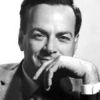
Richard P. Feynman
Richard Phillips Feynmanwas an American theoretical physicist known for his work in the path integral formulation of quantum mechanics, the theory of quantum electrodynamics, and the physics of the superfluidity of supercooled liquid helium, as well as in particle physics for which he proposed the parton model. For his contributions to the development of quantum electrodynamics, Feynman, jointly with Julian Schwinger and Sin-Itiro Tomonaga, received the Nobel Prize in Physics in 1965...
NationalityAmerican
ProfessionPhysicist
Date of Birth11 May 1918
CountryUnited States of America
There were several possible solutions of the difficulty of classical electrodynamics, any one of which might serve as a good starting point to the solution of the difficulties of quantum electrodynamics.
The universe is very large, and its boundaries are not known very well, but it is still possible to define some kind of a radius to be associated with it.
It is scientific only to say what is more likely and what less likely, and not to be proving all the time the possible and impossible.
So my antagonist said, "Is it impossible that there are flying saucers? Can you prove that it's impossible?" "No", I said, "I can't prove it's impossible. It's just very unlikely". At that he said, "You are very unscientific. If you can't prove it impossible then how can you say that it's unlikely?" But that is the way that is scientific. It is scientific only to say what is more likely and what less likely, and not to be proving all the time the possible and impossible.
I want to marry Arline because I love her - which means I want to take care of her. That is all there is to it. I want to take care of her. I am anxious for the responsibilities and uncertainties of taking care of the girl I love.
Reality must take precedence over public relations, for nature cannot be fooled.
If we have an atom that is in an excited state and so is going to emit a photon, we cannot say when it will emit the photon. It has a certain amplitude to emit the photon at any time, and we can predict only a probability for emission; we cannot predict the future exactly.
I thought one should have the attitude of 'What do you care what other people think!'
The fact that the colors in the flower have evolved in order to attract insects to pollinate it is interesting; that means insects can see the colors. That adds a question: does this aesthetic sense we have also exist in lower forms of life?
People often think I'm a faker, but I'm usually honest, in a certain way - in such a way that often nobody believes me!
It's the way I study - to understand something by trying to work it out or, in other words, to understand something by creating it. Not creating it one hundred percent, of course; but taking a hint as to which direction to go but not remembering the details. These you work out for yourself.
Each piece, or part, of the whole of nature is always merely an approximation to the complete truth, or the complete truth so far as we know it. In fact, everything we know is only some kind of approximation because we know that we do not know all the laws as yet.
We are at the very beginning of time for the human race. It is not unreasonable that we grapple with problems. But there are tens of thousands of years in the future. Our responsibility is to do what we can, learn what we can, improve the solutions, and pass them on.
Working out another system to replace Newton's laws took a long time because phenomena at the atomic level were quite strange. One had to lose one's common sense in order to perceive what was happening at the atomic level.