Richard P. Feynman
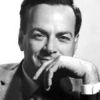
Richard P. Feynman
Richard Phillips Feynmanwas an American theoretical physicist known for his work in the path integral formulation of quantum mechanics, the theory of quantum electrodynamics, and the physics of the superfluidity of supercooled liquid helium, as well as in particle physics for which he proposed the parton model. For his contributions to the development of quantum electrodynamics, Feynman, jointly with Julian Schwinger and Sin-Itiro Tomonaga, received the Nobel Prize in Physics in 1965...
NationalityAmerican
ProfessionPhysicist
Date of Birth11 May 1918
CountryUnited States of America
Know how to solve every problem that has been solved.
Precise language is not the problem. Clear language is the problem.
The worthwhile problems are the ones you can really solve or help solve, the ones you can really contribute something to. No problem is too small or too trivial if we can really do something about it.
If we want to solve a problem that we have never solved before, we must leave the door to the unknown ajar
The problem of creating something new, but which is consistent with everything which has been seen before, is one of extreme difficulty.
Turbulence is the most important unsolved problem of classical physics.
No problem is too small or too trivial if we can really do something about it.
I want to marry Arline because I love her - which means I want to take care of her. That is all there is to it. I want to take care of her. I am anxious for the responsibilities and uncertainties of taking care of the girl I love.
Reality must take precedence over public relations, for nature cannot be fooled.
If we have an atom that is in an excited state and so is going to emit a photon, we cannot say when it will emit the photon. It has a certain amplitude to emit the photon at any time, and we can predict only a probability for emission; we cannot predict the future exactly.
I thought one should have the attitude of 'What do you care what other people think!'
The fact that the colors in the flower have evolved in order to attract insects to pollinate it is interesting; that means insects can see the colors. That adds a question: does this aesthetic sense we have also exist in lower forms of life?
People often think I'm a faker, but I'm usually honest, in a certain way - in such a way that often nobody believes me!
It's the way I study - to understand something by trying to work it out or, in other words, to understand something by creating it. Not creating it one hundred percent, of course; but taking a hint as to which direction to go but not remembering the details. These you work out for yourself.