Rudolf Steiner
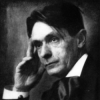
Rudolf Steiner
Rudolf Joseph Lorenz SteinerFebruary 1861 – 30 March 1925) was an Austrian philosopher, social reformer, architect and esotericist. Steiner gained initial recognition at the end of the nineteenth century as a literary critic and published philosophical works including The Philosophy of Freedom. At the beginning of the twentieth century he founded an esoteric spiritual movement, anthroposophy, with roots in German idealist philosophy and theosophy; other influences include Goethean science and Rosicrucianism...
NationalityAustrian
ProfessionPhilosopher
Date of Birth5 February 1861
CountryAustria
Rudolf Steiner quotes about
A real artist may create his picture in a lonely desert... gods look over his shoulder; he creates in their company. What does he care whether or not anybody admires his picture?
The task of art is to take hold of the shining, the radiance, the manifestation, of that which as spirit weaves and lives throughout the world. All genuine art seeks the spirit. Even when art wishes to represent the ugly, the disagreeable, it is concerned, not with the sensory - disagreeable as such, but with the spiritual which proclaims its nature in the midst of unpleasantness. If the spiritual shines through the ugly, even the ugly becomes beautiful. In art it is upon a relation to the spiritual that beauty depends.
Music is the expression of the will of nature while all other arts are expressions of the idea of nature.
It is the death of present art when it returns again and again to the model. Use of the model is only an intermediate stage in artistic development. Create out of a living spirituality to overcome everything naturalistic.
All real philosophers have been artists in the realm of concepts.
There will be as much deceit and criminality in the world as there is lack of art.
Die Kunst ist ewig, ihre Formen wandeln sich. (The art is eternal, their shapes are changing.)
Beauty is not the divine in a cloak of physical reality; no, it is physical reality in a cloak that is divine. The artist does not bring the divine on to the earth by letting it flow into the world; he raises the world into the sphere of the divine.
The basis of artistic creation is not what is, but what might be; not the real, but the possible. Artists create according to the same principles as nature, but they apply them to individual entities, while nature, to use a Goethean expression, thinks nothing of individual things. She is always building and destroying, because she wants to achieve perfection, not in the individual thing, but in the whole.
The heart of the Waldorf method is that education is an art-it must speak to the child's experience. To educate the whole child, his heart and his will must be reached, as well as the mind.
The science of the future will be based on sympathetic vibrations.
The thing itself is one; the images are many. What leads to a perceptive understanding of the thing is not the focus on one image, but the viewing of many images together.
Anthroposophie is not a religion but a tool for understanding of religions.
When sculpting the human figure in stone it is necessary to draw the whole form out of the content of the head.