Samuel Johnson
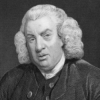
Samuel Johnson
Samuel Johnson, often referred to as Dr Johnson, was an English writer who made lasting contributions to English literature as a poet, essayist, moralist, literary critic, biographer, editor and lexicographer. Johnson was a devout Anglican and committed Tory, and has been described as "arguably the most distinguished man of letters in English history". He is also the subject of "the most famous single biographical work in the whole of literature," James Boswell's Life of Samuel Johnson...
NationalityEnglish
ProfessionNon-Fiction Author
Date of Birth18 September 1709
What I learned from being in France was learning to be better satisfied with my own country
Let no man rashly determine, that his unwillingness to be pleased is a proof of understanding, unless his superiority appears from less doubtful evidence; for though peevishness may sometimes justly boast its descent from learning or from wit, it is
Their learning is like bread in a besieged town: every man gets a little, but no man gets a full meal.
Nothing has tended more to retard the advancement of science than the disposition in vulgar minds to vilify what they cannot comprehend.
There is less flogging in our great schools than formerly-but then less is learned there; so what the boys get at one end they lose at the other.
To buried merit rise the tardy bust.
In order that all men might be taught to speak truth, it is necessary that all likewise should learn to hear it.
The chief art of learning, as Locke has observed, is to attempt but little at a time. The widest excursions of the mind are made by short flights frequently repeated; the most lofty fabrics of science are formed by the continued accumulation of single propositions.
Language is the dress of thought.
Knowledge is of two kinds. We know a subject ourselves, or we know where we can find information upon it.
It is better that some should be unhappy than that none should be happy, which would be the case in a general state of equality.
Our brightest blazes of gladness are commonly kindled by unexpected sparks.
It is better to remain silent and be thought a fool, than open one's mouth and remove all doubt.
It is easy to talk of sitting at home contented, when others are seeing or making shows. But not to have been where it is supposed, and seldom supposed falsely, that all would go if they could; to be able to say nothing when everyone is talking; to have no opinion when everyone is judging; to hear exclamations of rapture without power to depress; to listen to falsehoods without right to contradict, is, after all, a state of temporary inferiority, in which the mind is rather hardened by stubbornness, than supported by fortitude. If the world be worth winning let us enjoy it, if it is to be despised let us despise it by conviction. But the world is not to be despised but as it is compared with something better.