Wesley Clark
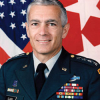
Wesley Clark
Wesley Kanne Clark, Sr.is a retired General of the United States Army. He graduated as valedictorian of the class of 1966 at West Point and was awarded a Rhodes Scholarship to the University of Oxford, where he obtained a degree in Philosophy, Politics and Economics. He later graduated from the Command and General Staff College with a master's degree in military science. He spent 34 years in the Army, receiving many military decorations, several honorary knighthoods, and the Presidential Medal...
NationalityAmerican
ProfessionWar Hero
Date of Birth23 December 1944
CityChicago, IL
CountryUnited States of America
I always said I would vote for a resolution that gave the president the leverage to go to the United Nations, and then come back to the Congress for the authority to go to force.
I'm running to be the president of the United States, not the vice president, and I will not accept that nomination, ... Meet the Press.
In the 1950s, Pakistan allied with the United States in something called the Central Treaty Organization. We were lined up with, at that time, Iran, ruled by the Shah, and Pakistan and Turkey as a southward shield against Soviet expansion toward the warm waters of the Indian Ocean and the Persian Gulf. It was part of the containment strategy.
Next to upholding the Constitution of the United States, the president's highest duty is to protect the security of this country - our national security.
I worked for the troops my entire time in the United States Armed Forces because we know in the United States Armed Forces that it's not the generals and the colonels that win battles, it's the soldiers: it's the people at the front, the mechanics with their wrenches, the drivers moving the logistics back in the rear.
People make mistakes. And one of the mistakes that the United States consistently made was that it could intervene and somehow adjust people's governments, especially in the Middle East.
For the United States to be a global leader, we have to have a very tight relationship with Europe. And we've held that relationship since 1949 when we established the North Atlantic Treaty Organization, NATO. NATO is the bond. It's a security bond.
This is kind of hard to articulate, but in broad outline, the United States is going to do what the United States has to do.
I think what you have to understand about the armed forces, ... it's a competitive bureaucracy. People enter it at the bottom and they come out at the top. There's a lot of gossip. There are some sharp elbows in there,
We're bringing in addition reconnaissance means and others, and I think we are having an effect, ... As I said in Washington a couple of days ago, we're winning, Milosevic is losing, and he knows it.
I think his disadvantage is that he doesn't seem to know who he is and he doesn't know what his policies are.
Just looking at the environment, the breakdown in Iraqi defense system, and the fact that we're in there in that urban area, we're not a good target for the use of chemical weapons even if Saddam could throw them at us, and I think the guess would be he can't at this point,
Our men and women fighting in Iraq are held accountable for their performance and their conduct. On duty and off, twenty-four hours a day. They're fighting for us, for our safety, our rights, and our freedoms.
Staying the course is not a strategy, it is just a slogan. ... We have a long way to go before victory, or at least some measure of success, is assured.