Alan Greenspan
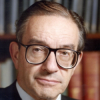
Alan Greenspan
Alan Greenspanis an American economist who served as Chairman of the Federal Reserve of the United States from 1987 to 2006. He currently works as a private adviser and provides consulting for firms through his company, Greenspan Associates LLC. First appointed Federal Reserve chairman by President Ronald Reagan in August 1987, he was reappointed at successive four-year intervals until retiring on January 31, 2006, after the second-longest tenure in the position...
NationalityAmerican
ProfessionEconomist
Date of Birth6 March 1926
CityNew York City, NY
CountryUnited States of America
The rate of growth of productivity cannot increase indefinitely, ... While there appears to be considerable expectation in the business community, and possibly Wall Street, that the productivity acceleration has not yet peaked, experience advises caution.
The rapid growth and increasing importance of derivative instruments in the risk profile of many large banks has been a particular concern,
We're going to see some erosion in a number of macroeconomic variables
What they perceive as newly abundant liquidity can readily disappear,
when we are at neutral, we will know it.
Unless the situation is reversed, at some point these budget trends will cause serious economic disruptions,
through education and training, not by restraining the competitive forces that are so essential to overall rising standards of living of the great majority of our population.
Throughout all this history, the CEA has, in most cases, provided the president with the best economic advice available at the time and has, crucially, been a consistent advocate for the importance of market forces,
Through most of last year's slowdown, in contrast to the usual pattern, the household sector was a major stabilizing force, ... As a consequence, although household spending should continue to trend up, the potential for significant acceleration in activity in this sector is more limited.
the possibility that the forces from Asia might damp activity and prices by more than is desirable.
We are seeing an evolving new international economy. We are in the process of learning how it works as we are doing it, ... Fortunately, the trauma that came out of the Russian default created so much risk aversion ... we probably have time to be deliberative in determining how the (international monetary) structure ought to be structured.
Until we experience an economic slowdown, we will not know for sure how much of the extraordinary rise in output per hour in the past five years is attributable to the irreversible way value is created and how much reflects endeavors on the part of the business community to stretch existing capital and labor resources in ways that are not sustainable over the long run,
Until market forces, assisted by a vigilant Federal Reserve, affect the necessary alignment of aggregate demand with the growth of potential aggregate supply, the full benefits of innovative productivity acceleration are at risk of being undermined by financial and economic instability,
I believe that the general growth in large [financial] institutions have occurred in the context of an underlying structure of markets in which many of the larger risks are dramatically -- I should say, fully -- hedged.