Albert Einstein
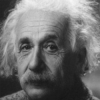
Albert Einstein
Albert Einstein; 14 March 1879 – 18 April 1955) was a German-born theoretical physicist. He developed the general theory of relativity, one of the two pillars of modern physics.:274 Einstein's work is also known for its influence on the philosophy of science. Einstein is best known in popular culture for his mass–energy equivalence formula E = mc2. He received the 1921 Nobel Prize in Physics for his "services to theoretical physics", in particular his discovery of the law of the photoelectric...
NationalityGerman
ProfessionScientist
Date of Birth14 March 1879
CityUlm, Germany
CountryGermany
Who would have thought around 1900 that in fifty years time we would know so much more and understand so much less.
There has been an earth for a little more than a billion years. As for the question of the end of it I advise: Wait and see!
What is significant in one's own existence one is hardly aware, and it certainly should not bother the other fellow. What does a fish know about the water in which he swims all his life?
Make a lot of walks to get healthy and don't read that much but save yourself some until you're grown up.
My God may not be your idea of God, but one thing I know of my God he makes me a humanitarian. I am a proud Jew because we gave the world the Bible and the story of Joseph.
Indeed, it is not intellect, but intuition which advances humanity. Intuition tells man his purpose in this life.
I have also considered many scientific plans during my pushing you around in your pram!
Science can only state what is, not what should be.
Philosophy is empty if it isn't based on science. Science discovers, philosophy interprets.
Anonymity is no excuse for stupidity.
Compound interest is the eighth natural wonder of the world and the most powerful thing I have ever encountered.
Time is just something we invented to make motion seem simple.
It would be foolish to despise tradition. But with our growing self-consciousness and increasing intelligence we must begin to control tradition and assume a critical attitude toward it, if human relations are ever to change for the better.
[Kepler] had to realize clearly that logical-mathematical theoretizing, no matter how lucid, could not guarantee truth by itself; that the most beautiful logical theory means nothing in natural science without comparison with the exactest experience. Without this philosophic attitude, his work would not have been possible.