Albert Einstein
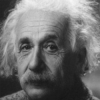
Albert Einstein
Albert Einstein; 14 March 1879 – 18 April 1955) was a German-born theoretical physicist. He developed the general theory of relativity, one of the two pillars of modern physics.:274 Einstein's work is also known for its influence on the philosophy of science. Einstein is best known in popular culture for his mass–energy equivalence formula E = mc2. He received the 1921 Nobel Prize in Physics for his "services to theoretical physics", in particular his discovery of the law of the photoelectric...
NationalityGerman
ProfessionScientist
Date of Birth14 March 1879
CityUlm, Germany
CountryGermany
Have the courage to take your own thoughts seriously, for they will shape you.
More and more I come to value charity and love of one's fellow being above everything else...All our lauded technological progress-our very civilization-is like the axe in the hand of the pathological criminal.
I see in Nature a magnificent structure... that must fill a thinking person with a feeling of humility...
Generations to come will find it difficult to believe that a man such as Gandhi ever walked the face of this earth.
Nothing truly valuable can be achieved except by the unselfish cooperation of many individuals.
How can cosmic religious feeling be communicated from one person to another, if it can give rise to no definite notion of a God and no theology? In my view, it is the most important function of art and science to awaken this feeling and keep it alive in those who are receptive to it.
It has become appallingly clear that our technology has surpassed our humanity. I hope that someday, our humanity might yet surpass our technology.
It is quite clear to me that the religious paradise of youth, which [I] lost, was a first attempt to free myself from the chains of the 'merely personal,' from an existence which is dominated by wishes, hopes, and primitive feelings.
I have never belonged wholeheartedly to a country, a state, nor to a circle of friends, nor even to my own family. When I was still a rather precocious young man, I already realized most vividly the futility of the hopes and aspirations that most men pursue throughout their lives. Well-being and happiness never appeared to me as an absolute aim. I am even inclined to compare such moral aims to the ambitions of a pig.
Albert is a very poor student. He is mentally slow, unsociable and is always daydreaming. He is spoiling it for the rest of the class. It would be in the best interests of all if he were removed from school immediately.
My internal and external life depend so much on the work of others that I must make an extreme effort to give as much as I receive.
It is impossible to get out of a problem by using the same kind of thinking that it took to get into it.
"There's been a quantum leap technologically in our age, but unless there's another quantum leap in human relations, unless we learn to live in a new way towards one another, there will be a catastrophe."
I am strongly drawn to the simple life and am often oppressed by the feeling that I am engrossing an unnecessary amount of the labour of my fellow men. I regard class differences as contrary to justice and, in the last resort, based on force. I also consider that plain living is good for everybody, physically and mentally.