Andrew Carnegie
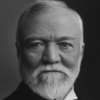
Andrew Carnegie
Andrew Carnegiewas a Scottish-American industrialist who led the enormous expansion of the American steel industry in the late 19th century. He is often identified as one of the richest people in history, alongside John D. Rockefeller and Jakob Fugger. He built a leadership role as a philanthropist for the United States and the British Empire. During the last 18 years of his life, he gave away to charities, foundations, and universities about $350 million– almost 90 percent of his fortune...
NationalityScottish
ProfessionEntrepreneur
Date of Birth25 November 1835
CityDunfermline, Scotland
A word, a look, an accent, may affect the destiny not only of individuals, but of nations. He is a bold man who calls anything a trifle.
A man who was generous with his wealth. It has been reported that during his lifetime, Carnegie gave away over $350 million of his money to help others.
In [my] life ... I did not understand steam machinery, but I tried to understand that much more complicated piece of mechanism - man.
The battle of life is already half won by the young man who is brought in contact with high officials; and the great aim of every boy should be to do something beyond the sphere of his duties- something which attracts the attention of those over him.
Here lies one who knew how to get around him men who were cleverer than himself
Men who reach decisions promptly usually have the capacity to move with definiteness of purpose in other circumstances.
The public only knows one side of [Mark Mark Twain] - the amusing part. Little does it suspect that he was a man of strong convictions upon political and social questions and a moralist of no mean order.
There is scarcely an instance of a man who has made a fortune by speculation and kept it
Nothing tells in the long run like a good judgment, and no sound judgment can remain with the man whose mind is disturbed by the mercurial changes of the stock exchange. It places him under an influence akin to intoxication. What is not, he sees, and what he sees, is not.
I began to learn what poverty meant. It was burnt in my heart then that my father had to beg for work and there came the resolve that I would cure that when I got to be a man.
The man who dies rich, dies disgraced.
I don't believe in God. My God is patriotism. Teach a man to be a good citizen and you have solved the problem of life.
You must capture and keep the heart of the original and supremely able man before his brain can do its best.
I wish to have as my epitaph: 'Here lies a man who was wise enough to bring into his service men who knew more than he.'