Aristotle
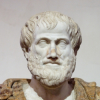
Aristotle
Aristotle was a Greek philosopher and scientist born in the city of Stagira, Chalkidice, on the northern periphery of Classical Greece. His father, Nicomachus, died when Aristotle was a child, whereafter Proxenus of Atarneus became his guardian. At eighteen, he joined Plato's Academy in Athens and remained there until the age of thirty-seven. His writings cover many subjects – including physics, biology, zoology, metaphysics, logic, ethics, aesthetics, poetry, theater, music, rhetoric, linguistics, politics and government – and constitute the first comprehensive system...
NationalityGreek
ProfessionPhilosopher
Emotions of any kind are produced by melody and rhythm; therefore by music a man becomes accustomed to feeling the right emotions; music has thus the power to form character, and the various kinds of music based on various modes may be distinguished by their effects on character.
We are what we repeatedly do... excellence, therefore, isn't just an act, but a habit and life isn't just a series of events, but an ongoing process of self-definition.
There is no such thing as committing adultery with the right woman, at the right time, and in the right way, for it is simply WRONG.
It seems that ambition makes most people wish to be loved rather than to love others.
Excellence is not an art. It is the habit of practice.
Hippodamus, son of Euryphon, a native of Miletus, invented the art of planning and laid out the street plan of Piraeus.
The rattle is a toy suited to the infant mind, and education is a rattle or toy for children of larger growth.
When the looms spin by themselves, we'll have no need for slaves.
A life of wealth and many belongings is only a means to happiness. Honor, power, and success cannot be happiness because they depend on the whims of others, and happiness should be self-contained, complete in itself.
That which is excellent endures.
Art is a higher type of knowledge than experience.
The structural unity of the parts is such that, if any one of them is displaced or removed, the whole will be disjointed and disturbed. For a thing whose presence or absence makes no visible difference is not an organic part of the whole.
It is not sufficient to know what one ought to say, but one must also know how to say it.
The character which results from wealth is that of a prosperous fool.