Aristotle
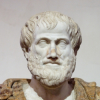
Aristotle
Aristotle was a Greek philosopher and scientist born in the city of Stagira, Chalkidice, on the northern periphery of Classical Greece. His father, Nicomachus, died when Aristotle was a child, whereafter Proxenus of Atarneus became his guardian. At eighteen, he joined Plato's Academy in Athens and remained there until the age of thirty-seven. His writings cover many subjects – including physics, biology, zoology, metaphysics, logic, ethics, aesthetics, poetry, theater, music, rhetoric, linguistics, politics and government – and constitute the first comprehensive system...
NationalityGreek
ProfessionPhilosopher
The science that studies the supreme good for man is politics.
There is no genius who hasn't a touch of insanity.
Where your talents and the needs of the world cross, therein lies your vocation. These two, your talents and the needs of the world, are the great wake up calls to your true vocation in life... to ignore this, is in some sense, is to lose your soul.
The aim of education is to make the pupil like and dislike what he ought....The little human animal will not at first have the right responses. It must be trained to feel pleasure, liking, disgust, and hatred at those things which really are pleasant, likable, disgusting, and hateful.
Our actions determine our dispositions.
I seek to bring forth what you almost already know.
If everything when it occupies an equal space is at rest, and if that which is in locomotion is always occupying such a space at any moment, the flying arrow is therefore motionless.
That which is in locomotion must arrive at the half-way stage before it arrives at the goal. (Travel over any finite distance can neither be completed nor begun, and so all motion must be an illusion.)
In a race, the quickest runner can never overtake the slowest, since the pursuer must first reach the point whence the pursued started, so that the slower must always hold a lead.
Man by Nature desires to know.
Nothing in life is more necessary than friendship.
The true friend of the people should see that they be not too poor, for extreme poverty lowers the character of the democracy.
All people by nature desire to know. An example of this is the delight we take in our senses; for even apart from their usefulness they are loved for themselves.
The wise man knows of all things, as far as possible, although he has no knowledge of each of them in detail