Arthur Eddington
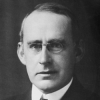
Arthur Eddington
Sir Arthur Stanley Eddington OM FRSwas an English astronomer, physicist, and mathematician of the early 20th century who did his greatest work in astrophysics. He was also a philosopher of science and a popularizer of science. The Eddington limit, the natural limit to the luminosity of stars, or the radiation generated by accretion onto a compact object, is named in his honor...
NationalityBritish
ProfessionScientist
Date of Birth28 December 1882
science causes force
Electrical force is defined as something which causes motion of electrical charge; an electrical charge is something which exerts electric force.
grace events happens
Events do not happen; they are just there, and we come across them.
thinking two study
We often think that when we have completed our study of one we know all about two, because 'two' is 'one and one.' We forget that we still have to make a study of 'and.'
lines uniforms body
Every body continues in its state of rest or uniform motion in a straight line, except insofar as it doesn't.
statistics theory results
It is also a good rule not to put overmuch confidence in the observational results that are put forward until they are confirmed by theory.
past law differences
There is only one law of Nature-the second law of thermodynamics-which recognises a distinction between past and future more profound than the difference of plus and minus. It stands aloof from all the rest. ... It opens up a new province of knowledge, namely, the study of organisation; and it is in connection with organisation that a direction of time-flow and a distinction between doing and undoing appears for the first time.
stars men important
Man is slightly nearer to the atom than to the star. ... From his central position man can survey the grandest works of Nature with the astronomer, or the minutest works with the physicist. ... [K]nowledge of the stars leads through the atom; and important knowledge of the atom has been reached through the stars.
knowledge theory amount
Something unknown is doing we don't know what-that is what our theory amounts to.
knowledge waiting lists
There was a time when we wanted to be told what an electron is. The question was never answered. No familiar conceptions can be woven around the electron; it belongs to the waiting list.
knowledge law mind
Unless the structure of the nucleus has a surprise in store for us, the conclusion seems plain-there is nothing in the whole system if laws of physics that cannot be deduced unambiguously from epistemological considerations. An intelligence, unacquainted with our universe, but acquainted with the system of thought by which the human mind interprets to itself the contents of its sensory experience, and should be able to attain all the knowledge of physics that we have attained by experiment.
smart writing people
On one occasion when [William] Smart found him engrossed with his fundamental theory, he asked Eddington how many people he thought would understand what he was writing-after a pause came the reply, 'Perhaps seven.'
dodge wave mechanic
Schrodinger's wave-mechanics is not a physical theory but a dodge-and a very good dodge too.
giving lines may
When an investigator has developed a formula which gives a complete representation of the phenomena within a certain range, he may be prone to satisfaction. Would it not be wiser if he should say 'Foiled again! I can find out no more about Nature along this line.'
soul needs levers
Our model of Nature should not be like a building-a handsome structure for the populace to admire, until in the course of time some one takes away a corner stone and the edifice comes toppling down. It should be like an engine with movable parts. We need not fix the position of any one lever; that is to be adjusted from time to time as the latest observations indicate. The aim of the theorist is to know the train of wheels which the lever sets in motion-that binding of the parts which is the soul of the engine.