Arthur Schopenhauer
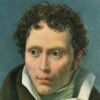
Arthur Schopenhauer
Arthur Schopenhauerwas a German philosopher. He is best known for his 1818 work The World as Will and Representation, in which he characterizes the phenomenal world as the product of a blind, insatiable, and malignant metaphysical will. Proceeding from the transcendental idealism of Immanuel Kant, Schopenhauer developed an atheistic metaphysical and ethical system that has been described as an exemplary manifestation of philosophical pessimism, rejecting the contemporaneous post-Kantian philosophies of German idealism. Schopenhauer was among the first thinkers in Western...
NationalityGerman
ProfessionPhilosopher
Date of Birth22 February 1788
CountryGermany
Physics is unable to stand on its own feet, but needs a metaphysics on which to support itself, whatever fine airs it may assume towards the latter.
Consciousness is the mere surface of our minds, of which, as of the earth, we do not know the inside, but only the crust.
The beard, being a half-mask, should be forbidden by the police - It is, moreover, as a sexual symbol in the middle of the face, obscene: that is why it pleases women.
Apart from man, no being wonders at its own experience.
A major difficulty in translation is that a word in one language seldom has a precise equivalent in another one.
Pantheism is only a polite form of atheism.
Most men are so thoroughly subjective that nothing really interests them but themselves.
Every possession and every happiness is but lent by chance for an uncertain time, and may therefore be demanded back the next hour.
Knowledge is to certain extent a second existence.
History is the long, difficult and confused dream of Mankind.
...this our world, which is so real, with all its suns and milky ways is-nothing.
All wanting comes from need, therefore from lack, therefore from suffering.
The auspices for philosophy are bad if, when proceeding ostensibly on the investigation of truth, we start saying farewell to all uprightness, honesty and sincerity, and are intent only on passing ourselves off for what we are not. We then assume, like those three sophists [Fichte, Schelling and Hegel], first a false pathos, then an affected and lofty earnestness, then an air of infinite superiority, in order to impose where we despair of ever being able to convince.
Just as a stream flows smoothly on as long as it encounters no obstruction, so the nature of man and animal is such that we never really notice or become conscious of what is agreeable to our will; if we are to notice something, our will has to have been thwarted, has to have experienced a shock of some kind.