Auguste Comte
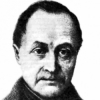
Auguste Comte
Isidore Auguste Marie François Xavier Comte, better known as Auguste Comte, was a French philosopher. He was a founder of the discipline of sociology and of the doctrine of positivism. He is sometimes regarded as the first philosopher of science in the modern sense of the term...
NationalityFrench
ProfessionSociologist
Date of Birth17 February 1798
CountryFrance
knowledge mean law
In the final, the positive, state, the mind has given over the vain search after absolute notions, the origin and destination of the universe, and the causes of phenomena, and applies itself to the study of their laws-that is, their invariable relations of succession and resemblance. Reasoning and observation, duly combined, are the means of this knowledge. What is now understood when we speak of an explanation of facts is simply the establishment of a connection between single phenomena and some general facts.
mind atheism proof
The universe displays no proof of an all-directing mind.
moving mean order
The mathematical thermology created by Fourier may tempt us to hope that, as he has estimated the temperature of the space in which we move, me may in time ascertain the mean temperature of the heavenly bodies: but I regard this order of facts as for ever excluded from our recognition. We can never learn their internal constitution, nor, in regard to some of them, how heat is absorbed by their atmosphere. We may therefore define Astronomy as the science by which we discover the laws of the geometrical and mechanical phenomena presented by the heavenly bodies.
science views scientific-method
Induction for deduction, with a view to construction.
math science
C'este donc par l'étude des mathématiques, et seulement par elle, que l'on peut se faire une idée juste et approfondie de ce que c'est qu'une science.
tradition
The dead govern the living.
country august want
But now, I, August Comte, have discovered the truth. Therefore, there is no longer any need for freedom of thought or freedom of the press. I want to rule and to organize the whole country.
thinking moral chemistry
If we do not allow free thinking in chemistry or biology, why should we allow it in morals or politics?
knows
To understand a science it is necessary to know its history.
humanity made
Humanity is always made up of more dead than living.
absolutes relative
Everything is relative; and only that is absolute.
women humanity elements
Woman is the most moral element in all humanity.
ideas world chaos
Ideas govern the world, or throw it into chaos.
would-be facts different
Every science consists in the coordination of facts; if the different observations were entirely isolated, there would be no science.