Benjamin Franklin
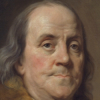
Benjamin Franklin
Benjamin Franklinwas one of the Founding Fathers of the United States. A renowned polymath, Franklin was a leading author, printer, political theorist, politician, freemason, postmaster, scientist, inventor, civic activist, statesman, and diplomat. As a scientist, he was a major figure in the American Enlightenment and the history of physics for his discoveries and theories regarding electricity. As an inventor, he is known for the lightning rod, bifocals, and the Franklin stove, among other inventions. He facilitated many civic organizations, including...
NationalityAmerican
ProfessionScientist
Date of Birth17 January 1706
CityBoston, MA
CountryUnited States of America
Man is a tool-making animal
What you would seem to be, be really.
The most exquisite folly is made of wisdom spun too fine.
Presumption first blinds a man, then sets him a running.
I wish the bald eagle had not been chosen as the representative of our country; he is a bird of bad moral character; like those among men who live by sharping and robbing, he is generally poor, and often very lousy. The turkey is a much more respectable bird, and withal a true original native of America.
"We hold these truths to be sacred and undeniable" in a draft of the Declaration of Independence changes it instead into an assertion of rationality. The scientific mind of Franklin drew on the scientific determinism of Isaac Newton and the analytic empiricism of David Hume and Gottfried Leibniz. In what became known as "Hume's Fork" the latters' theory distinguished between synthetic truths that describe matters of fact, and analytic truths that are self-evident by virtue of reason and definition.
Nor is it of much Importance to us to know the Manner in which Nature executes her laws; 'tis enough to know the Laws themselves.
Take the money in your wallet and invest it in your mind. And in return, your mind will fill up your wallet!
He that lives well, is learned enough.
Three things are men most likely to be cheated in, a horse, a wig, and a wife.
Hereafter, if you should observe an occasion to give your officers and friends a little more praise than is their due, and confess more fault than you can justly be charged with, you will only become the sooner for it, a great captain.
People who are willing to give up freedom for the sake of short term security, deserve neither freedom nor security.
Acquire Riches by Industry and Frugality.
They that can give up essential liberty to obtain a little temporary safety deserve neither liberty nor safety. This sentence was much used in the Revolutionary period. It occurs even so early as November, 1755, in an answer by the Assembly of Pennsylvania to the Governor, and forms the motto of Franklin's "Historical Review," 1759, appearing also in the body of the work. -Frothingham: Rise of the Republic of the United States, p. 413.