Benoit Mandelbrot
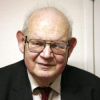
Benoit Mandelbrot
Benoit B. Mandelbrot was a Polish-born, French and American mathematician with broad interests in the practical sciences, especially regarding what he labeled as "the art of roughness" of physical phenomena and "the uncontrolled element in life." He referred to himself as a "fractalist". He is recognized for his contribution to the field of fractal geometry, which included coining the word "fractal'", as well as developing a theory of "roughness and self-similarity" in nature...
NationalityFrench
ProfessionMathematician
Date of Birth20 November 1924
CountryFrance
I spent half my life, roughly speaking, doing the study of nature in many aspects and half of my life studying completely artificial shapes. And the two are extraordinarily close; in one way both are fractal.
Think of color, pitch, loudness, heaviness, and hotness. Each is the topic of a branch of physics
Clouds are not spheres, mountains are not cones, coastlines are not circles, and bark is not smooth, nor does lightning travel in a straight line.
Smooth shapes are very rare in the wild but extremely important in the ivory tower and the factory
It was a very big gamble. I lost my job in France, I received a job in which was extremely uncertain, how long would IBM be interested in research, but the gamble was taken and very shortly afterwards, I had this extraordinary fortune of stopping at Harvard to do a lecture and learning about the price variation in just the right way.
An extraordinary amount of arrogance is present in any claim of having been the first in inventing something.
The most complex object in mathematics, the Mandelbrot Set ... is so complex as to be uncontrollable by mankind and describable as 'chaos'.
Being a language, mathematics may be used not only to inform but also, among other things, to seduce.
Many painters had a clear idea of what fractals are. Take a French classic painter named Poussin. Now, he painted beautiful landscapes, completely artificial ones, imaginary landscapes. And how did he choose them? Well, he had the balance of trees, of lawns, of houses in the distance. He had a balance of small objects, big objects, big trees in front and his balance of objects at every scale is what gives to Poussin a special feeling.
A fractal is a way of seeing infinity.
A formula can be very simple, and create a universe of bottomless complexity.
The most important thing I have done is to combine something esoteric with a practical issue that affects many people.
Regular geometry, the geometry of Euclid, is concerned with shapes which are smooth, except perhaps for corners and lines, special lines which are singularities, but some shapes in nature are so complicated that they are equally complicated at the big scale and come closer and closer and they don't become any less complicated.
Think not of what you see, but what it took to produce what you see.