Bertrand Russell
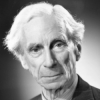
Bertrand Russell
Bertrand Arthur William Russell, 3rd Earl Russell, OM, FRSwas a British philosopher, logician, mathematician, historian, writer, social critic, political activist and Nobel laureate. At various points in his life he considered himself a liberal, a socialist, and a pacifist, but he also admitted that he had "never been any of these things, in any profound sense". He was born in Monmouthshire into one of the most prominent aristocratic families in the United Kingdom...
NationalityBritish
ProfessionPhilosopher
Date of Birth18 May 1872
The essence of education is that it is a change effected in the organism to satisfy the operator.
You, your families, your friends and your countries are to be exterminated by the common decision of a few brutal but powerful men. To please these men, all the private affections, all the public hopes, all that has been achieved in art, and knowledge and thought and all that might be achieved hereafter is to be wiped out forever. Our ruined lifeless planet will continue for countless ages to circle aimlessly round the sun unredeemed by the joys and loves, the occasional wisdom and the power to create beauty which have given value to human life.
The tendency of our perceptions is to emphasise increasingly the objective elements in an impression, unless we have some special reason, as artists have, for doing the opposite.
[Freedom] is the greatest of political goods. I do not say freedom is the greatest of all goods: the best things come from within they are such things as creative art, and love, and thought. Such things can be helped or hindered by political conditions, but not actually produced by them; and freedom is, both in itself and in its relation to these other goods the best thing that political and economic conditions can secure.
Mathematics, rightly viewed, possesses not only truth, but supreme beauty-a beauty cold and austere ... yet sublimely pure and capable of stern perfection such as only the greatest art can show.
There is an artist imprisoned in each one of us. Let him loose to spread joy everywhere.
Philosophy, for Plato, is a kind of vision, the 'vision of truth'...Everyone who has done any kind of creative work has experienced, in a greater or less degree, the state of mind in which, after long labour, truth or beauty appears, or seems to appear, in a sudden glory - it may only be about some small matter, or it may be about the universe. I think that most of the best creative work, in art, in science, in literature, and in philosophy, has been a result of just such a moment.
The main things which seem to me important on their own account, and not merely as means to other things, are knowledge, art, instinctive happiness, and relations of friendship or affection.
Ethics is in origin the art of recommending to others the sacrifices required for cooperation with oneself.
Very few men can be genuinely happy in a life involving continual self-assertion against the skepticism of the mass of mankind, unless they can shut themselves up in a coterie and forget the cold outer world. The man of science has no need of a coterie, since he is thought well of by everybody except his colleagues. The artist, on the contrary, is in the painful situation of having to choose between being despised and being despicable.
Artists are on the average less happy than men of science.
There will still be things that machines cannot do. They will not produce great art or great literature or great philosophy; they will not be able to discover the secret springs of happiness in the human heart; they will know nothing of love and friendship.
In science the successors stand upon the shoulders of their predecessors; where one man of supreme genius has invented a method, a thousand lesser men can apply it. ... In art nothing worth doing can be done without genius; in science even a very moderate capacity can contribute to a supreme achievement.
The significance of a fact is relative to [the general body of scientific] knowledge. To say that a fact is significant in science, is to say that it helps to establish or refute some general law; for science, though it starts from observation of the particular, is not concerned essentially with the particular, but with the general. A fact, in science, is not a mere fact, but an instance. In this the scientist differs from the artist, who, if he deigns to notice facts at all, is likely to notice them in all their particularity.