Bertrand Russell
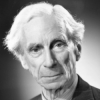
Bertrand Russell
Bertrand Arthur William Russell, 3rd Earl Russell, OM, FRSwas a British philosopher, logician, mathematician, historian, writer, social critic, political activist and Nobel laureate. At various points in his life he considered himself a liberal, a socialist, and a pacifist, but he also admitted that he had "never been any of these things, in any profound sense". He was born in Monmouthshire into one of the most prominent aristocratic families in the United Kingdom...
NationalityBritish
ProfessionPhilosopher
Date of Birth18 May 1872
It is not by prayer and humility that you cause things to go as you wish, but by acquiring a knowledge of natural laws
Some kind of philosophy is a necessity to all but the most thoughtless, and in the absence of knowledge it is almost sure to be a silly philosophy.
Pure mathematics consists entirely of assertions to the effect that, if such and such a proposition is true of anything, then suchand such another proposition is true of that thing.... Thus mathematics may be defined as the subject in which we never know what we are talking about, nor whether what we are saying is true.
Whatever we know without inference is mental.
History is valuable, to begin with, because it is true; and this, though not the whole of its value, is the foundation and condition of all the rest. That all knowledge, as such, is in some degree good, would appear to be at least probable; and the knowledge of every historical fact possesses this element of goodness, even if it posses no other.
While the dogmatist is harmful, the sceptic is useless ...; one is certain of knowing, the other of not knowing. What philosophy should dissipate is certainty, whether of knowledge or of ignorance. Knowledge is not so precise a concept as is commonly thought. Instead of saying 'I know this', we ought to say 'I more or less know something more or less like this'. ... Knowledge in practical affairs has not the certainty or the precision of arithmetic.
All that passes for knowledge can be arranged in a hierarchy of degrees of certainty, with arithmetic and the facts of perception at the top.
Right conduct can never, except by some rare accident, be promoted by ignorance or hindered by knowledge.
I hold all knowledge that is concerned with things that actually exist - all that is commonly called Science - to be of very slight value compared to the knowledge which, like philosophy and mathematics, is concerned with ideal and eternal objects, and is freed from this miserable world which God has made.
What men really want is not knowledge but certainty.
There is no nonsense so errant that it cannot be made the creed of the vast majority by adequate governmental action.
The pursuit of knowledge is, I think, mainly actuated by love of power
Philosophy is that part of science which at present people chose to have opinions about, but which they have no knowledge about. Therefore every advance in knowledge robs philosophy of some problems which formerly it had ...and will belong to science.
The scientific attitude of mind involves a sweeping away of all other desires in the interest of the desire to know.