Blaise Pascal
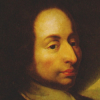
Blaise Pascal
Blaise Pascalwas a French mathematician, physicist, inventor, writer and Christian philosopher. He was a child prodigy who was educated by his father, a tax collector in Rouen. Pascal's earliest work was in the natural and applied sciences where he made important contributions to the study of fluids, and clarified the concepts of pressure and vacuum by generalising the work of Evangelista Torricelli. Pascal also wrote in defence of the scientific method...
NationalityFrench
ProfessionPhilosopher
Date of Birth19 June 1623
CityClermont-Ferrand, France
CountryFrance
Man is nothing but insincerity, falsehood, and hypocrisy, both in regard to himself and in regard to others. He does not wish that he should be told the truth, he shuns saying it to others; and all these moods, so inconsistent with justice and reason, have their roots in his heart.
All sorrow has its root in man's inability to sit quiet in a room by himself.
Nature imitates herself. A grain thrown into good ground brings forth fruit; a principle thrown into a good mind brings forth fruit. Everything is created and conducted by the same Master-the root, the branch, the fruits-the principles, the consequences.
Generally we are occupied either with the miseries which now we feel, or with those which threaten; and even when we see ourselves sufficiently secure from the approach of either, still fretfulness, though unwarranted by either present or expected affliction, fails not to spring up from the deep recesses of the heart, where its roots naturally grow, and to fill the soul with its poison.
Reason's last step is the recognition that there are an infinite number of things which are beyond it
Who would desire to have for a friend a man who talks in this fashion? Who would choose him out from others to tell him of his affairs? Who would have recourse to him in affliction? And indeed to what use in life could one put him?
Kind words produce their images on men's souls.
Man's greatness lies in his power of thought.
Thus we never live, but we hope to live; and always disposing ourselves to be happy, it is inevitable that we never become so.
Thus our first interest and our first duty is to enlighten ourselves on this subject, whereon depends all our conduct. Therefore among those who do not believe, I make a vast difference between those who strive with all their power to inform themselv
The power of a man's virtue should not be measured by his special efforts, but by his ordinary doing
If all persons knew what they said of each other there would not be four friends in the world
If we would say that man is too insignificant to deserve communion with God, we must indeed be very great to judge of it.
I have made this letter longer than usual because I lack the time to make it shorter