Calvin Coolidge
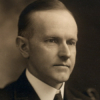
Calvin Coolidge
John Calvin Coolidge Jr.was the 30th President of the United States. A Republican lawyer from Vermont, Coolidge worked his way up the ladder of Massachusetts state politics, eventually becoming governor of that state. His response to the Boston Police Strike of 1919 thrust him into the national spotlight and gave him a reputation as a man of decisive action. Soon after, he was elected as the 29th vice president in 1920 and succeeded to the presidency upon the sudden death...
NationalityAmerican
ProfessionUS President
Date of Birth4 July 1872
CountryUnited States of America
One of the greatest favors that can be bestowed upon the American people is economy in government.
The president stands between the twin mirrors of the past and future, causing his being to become reflected an infinite amount of times. At first, this can be very disorienting. But it induces the president to move quickly. He may, for example, mimic a wave with his arms in order to see how his actions extend across this mirroring of time, observing if the figure at the end acts at the same instant as the figure before him, and so on and so forth.
A colored man is precisely as much entitled to submit his candidacy in a party primary, as is any other citizen. The decision must be made by the constituents to whom he offers himself, and by nobody else.
America has many glories. The last one that she would wish to surrender is the glory of the men who have served her in war. While such devotion lives, the nation is secure. Whatever dangers may threaten from within or without, she can view them calmly. Turning to her veterans, she can say: 'These are our defenders. They are invincible. In them is our safety.
July 4, 1776 was the historic day on which the representatives of three millions of people vocalized Concord, and Lexington, and Bunker Hill, which gave notice to the world that they proposed to establish an independent nation on the theory that all men are created equal, that they are endowed by their creator with certain inalienable rights, that among these are life, liberty, and the pursuit of happiness.
Numbered among our population are some 12,000,000 colored people. Under our Constitution their rights are just as sacred as those of any other citizen. It is both a public and a private duty to protect those rights. The Congress ought to exercise all its powers of prevention and punishment against the hideous crime of lynching, of which the negroes are by no means the sole sufferers, but for which they furnish a majority of the victims.
There are racial considerations too grave to be brushed aside for any sentimental reasons. Biological laws tell us that certain divergent people will not mix or blend. The Nordics propagate themselves successfully. With other races, the outcome shows deterioration on both sides. Quality of mind and body suggests that observance of ethnic law is as great a necessity to a nation as immigration law.
Everyone has an influence on public affairs if he will take the trouble to exert it.
Works which endure come from the soul of the people. The mighty in their pride walk alone to destruction. The humble walk hand in hand with providence to immortality. Their works survive.
A government which requires of the people the contribution of the bulk of their substance and rewards cannot be classed as a free government...
You can display no greater wisdom than by resisting proposals for needless legislation. It is much more important to kill bad bills than to pass good ones.
If you can get enough votes so that mine will make a majority, you can have it.
Look well to the hearthstone; therein all hope for America lies.
The government of a country never gets ahead of the religion of a country. There is no way by which we can substitute the authority of the law for the virtues of men