Calvin Coolidge
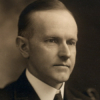
Calvin Coolidge
John Calvin Coolidge Jr.was the 30th President of the United States. A Republican lawyer from Vermont, Coolidge worked his way up the ladder of Massachusetts state politics, eventually becoming governor of that state. His response to the Boston Police Strike of 1919 thrust him into the national spotlight and gave him a reputation as a man of decisive action. Soon after, he was elected as the 29th vice president in 1920 and succeeded to the presidency upon the sudden death...
NationalityAmerican
ProfessionUS President
Date of Birth4 July 1872
CountryUnited States of America
It is only when people can feel that their lives and the property which their industry has produced today will continue to be safe...that there can be...stability of value and...economic progress...
Unless we lay our course in accordance with this principle, the great power for good in the world with which we have been intrusted by a Divine Providence will be turned to a power for evil.
While I do not think it was so intended I have always been of the opinion that this turned out to be much the best for me. I had no national experience. What I have ever been able to do has been the result of first learning how to do it. I am not gifted with intuition. I need not only hard work but experience to be ready to solve problems. The Presidents who have gone to Washington without first having held some national office have been at great disadvantage.
The country is not in good condition.
It has not been my fortune to know very much of Freemasonry, but I have had the great fortune to know many Freemasons and have been able in that way to judge the tree by its fruit. I know of your high ideals. I have seen that you hold your meetings in the presence of the open Bible, and I know that men who observe that formality have high sentiments of citizenship, of worth, and character. That is the strength of our Commonwealth and nation.
Christmas is not a time or a season but a state of mind.
Measured by the standards of men of their time, [the Pilgrims] were the humble of the earth. Measured by later accomplishments, they were the mighty. In appearance weak and persecuted they came -- rejected, despised -- an insignificant band; in reality strong and independent, a mighty host of whom the world was not worthy destined to free mankind.
Industry cannot flourish if labor languish.
It is hard to see how a great man can be an atheist. . . . We need to feel that behind us is intelligence and love.
No Congress of the United States ever assembled, on surveying the state of the Union, has met with a more pleasing prospect than that which appears at the present time. In the domestic field there is tranquillity and contentment, harmonious relations between management and wage earner, freedom from industrial strife, and the highest record of years of prosperity.
Government price-fixing once started, has alike no justice and no end. It is an economic folly from which this country has every right to be spared.
Public debt [is] a burden on all the people.
I should think that an ordinary copy of the King James version would have been good enough for those Congressmen.
[The political mind] is a strange mixture of vanity and timidity, of an obsequious attitude at one time and a delusion of grandeurat another time. The political mind is the product of men in public life who have been twice spoiled. They have been spoiled with praise and they have been spoiled with abuse.