Calvin Coolidge
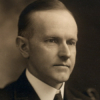
Calvin Coolidge
John Calvin Coolidge Jr.was the 30th President of the United States. A Republican lawyer from Vermont, Coolidge worked his way up the ladder of Massachusetts state politics, eventually becoming governor of that state. His response to the Boston Police Strike of 1919 thrust him into the national spotlight and gave him a reputation as a man of decisive action. Soon after, he was elected as the 29th vice president in 1920 and succeeded to the presidency upon the sudden death...
NationalityAmerican
ProfessionUS President
Date of Birth4 July 1872
CountryUnited States of America
I have found it advisable not to give too much heed to what people say when I am trying to accomplish something of consequence. Invariably they proclaim it can't be done. I deem that the very best time to make the effort.
Honorable Senators: My sincerest thanks I offer you. Conserve the firm foundations of our institutions. Do your work with the spirit of a soldier in the public service. Be loyal to the Commonwealth and to yourselves and be brief; above all be brief.
We cannot do everything at once, but we can do something at once.
In a republic the first rule for the guidance of the citizen is obedience of the law.
All growth depends upon activity. There is no development physically or intellectually without effort, and effort means work.
Anytime you don't want anything you get it.
There is no surer road to destruction than prosperity without character.
Freedom is not only bought with a great price; it is maintained by unremitting effort.
One day the President and Mrs. Coolidge were visiting a government farm. Soon after their arrival they were taken off on separate tours. When Mrs. Coolidge passed the chicken pens she paused to ask the man in charge if the rooster copulates more than once each day. "Dozens of times, was the reply." "Please tell that to the President," Mrs. Coolidge requested. When the President passed the pens and was told about the roosters, he asked "Same hen every time?" "Oh no, Mr. President, a different one each time." The President nodded slowly, then said, "Tell that to Mrs. Coolidge."
The best help that benevolence and philanthropy can give is that which induces everybody to help himself.
No person was ever honored for what he received. Honor has been the reward for what he gave.
Governments do not make ideals, but ideals make governments.
We do not need more intellectual power, we need more spiritual power. We do not need more of the things that are seen, we need more of the things that are unseen.
Governments do not make ideals, but ideals make governments. This is both historically and logically true. Of course the government can help to sustain ideals and can create institutions through which they can be the better observed, but their source by their very nature is in the people. The people have to bear their own responsibilities. There is no method by which that burden can be shifted to the government. It is not the enactment, but the observance of laws, that creates the character of a nation.