Chiang Kai-shek
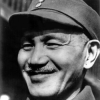
Chiang Kai-shek
Chiang Kai-shek, better known in China as Jiang Jieshi or Jiang Zhongzheng, was a Chinese political and military leader who served as the leader of the Republic of China between 1928 and 1975. Chiang was an influential member of the Kuomintang, the Chinese Nationalist Party, and was a close ally of Sun Yat-sen. He became the Commandant of the Kuomintang's Whampoa Military Academy and took Sun's place as leader of the KMT following the Canton Coup in early 1926. Having...
NationalityChinese
ProfessionPolitician
Date of Birth31 October 1887
CityXikou, China
CountryChina
We live in the present, we dream of the future and we learn eternal truths from the past.
The Japanese are a disease of the skin. The Communists are a disease of the heart.
War is not only a matter of equipment, artillery, group troops or air force; it is largely a matter of spirit, or morale.
China, with her five thousand years of history, her vast territory and her enormous population stands like a mountain peak among the nations of the world. Her contribution to the civilization of mankind is imperishable. She has been a keen lover of peace; she has had a deep respect for international justice.
I have always told my subordinates that when they commit any mistakes, the blame must be laid on the superior officers.
I have implicit faith in Sun Yat-sen, not because I am his blind follower, but because he really arouses the deepest respect in everybody. I do not know of another person in China who has such a broad and international outlook, whose ideas are so constructive, and who has such deep faith and confidence in his own mission.
We Chinese are instinctively democratic, and Dr. Sun's objective of universal suffrage evokes from all Chinese a ready and unhesitating response.
Externally China desires independence, internally she seeks to maintain her existence as a nation; China therefore strives to loose the bonds that bind her people, and to complete the establishment of a new State.
My father died when I was 9 years old. The miserable condition of my family at that time is beyond description. My family, solitary and without influence, became at once the target of much insult and abuse.
Modern warfare is by no means merely a matter of military operations. Economic affairs stand together with them in the first rank of the factors of importance.
I should like very much to go to America. I have heard so much of the great industrial and economic development of that great land, and I wish to see things for myself.
Contempt for China on the part of the enemy is his weak point. Knowledge of this weak point is our strong point.
The modern world is one wherein every nation has to develop the strength of which its citizens are capable. The independent status of the individual, his thoughts and actions become a thing of the past.
The idea of universal brotherhood is innate in the catholic nature of Chinese thought; it was the dominant concept of Dr. Sun Yat-sen, whom events have proved time and again to be not a visionary but one of the world's greatest realists.