Colin Powell
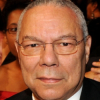
Colin Powell
Colin Luther Powell is an American statesman and a retired four-star general in the United States Army. He was the 65th United States Secretary of State, serving under U.S. President George W. Bush from 2001 to 2005, the first African American to serve in that position. During his military career, Powell also served as National Security Advisor, as Commander of the U.S. Army Forces Commandand as Chairman of the Joint Chiefs of Staff, holding the latter position during the Persian...
NationalityAmerican
ProfessionPolitician
Date of Birth5 April 1937
CityNew York City, NY
CountryUnited States of America
It is not up to Iraq to dictate the conditions to the United Nations, but for the United Nations to dictate the conditions to Iraq, ... If the United Nations does not act, then the United States, joined by other willing nations, must act.
There are a number of individuals in countries around the world who have been conveying the message to the Iraqi regime that it is now inevitable that there will be a change,
Baghdad fell on April 9, 2003, Hussein and his regime were brought down, we declared "Mission Accomplished" and celebrated victory . . . and chaos erupted. We did not assert control and authority over the country, especially Baghdad. We did not bring with us the capacity to impose our will. We did not take charge. And Iraq did not in a few weeks magically transform itself into a stable nation with democratic leaders. Instead a raging insurgency engulfed the country.
Nobody is ready to leave Iraq to be interviewed.
One of the most worrisome things that emerges from the thick intelligence file we have on Iraq's biological weapons is the existence of mobile production facilities used to make biological agents.
I'll tell you what they're all going to face - whichever one of them becomes president on Jan. 21 of 2009 - they will face a military force, a United States military force, that cannot sustain, continue to sustain, 140,000 people deployed in Iraq, and the 20 (to) 25,000 people we have deployed in Afghanistan, and our other deployments.
Change of regime with respect to Iraq had nothing to do with this; it had everything to do with the fact that Iraq had weapons of mass destruction. And at the time change in regime as a policy came into effect in 1998, it was seen as the only way to compel Iraq to get rid of its weapons of mass destruction.
With respect to our friends in the [Iraq] region, each has its own system, each will have to make its own judgment as to whether it will change, how fast it will change, and we hope that we can help influence them as to how change comes about and what change might be better for them than other forms of change.
The regime only allows interviews with inspectors in the presence of an Iraqi official, a minder, ... The official Iraqi organization charged with facilitating inspections announced, announced publicly and announced ominously that, 'Nobody is ready to leave Iraq to be interviewed.'
Finally, we will continue to consult with our friends, with our allies and with all members of the Security Council on how to compel compliance by Iraq with the will of the international community,
there is no indication whatsoever that Iraq has made the strategic decision to come clean and comply with its international obligation to disarm.
The oil fields are the property of the Iraqi people, and if a coalition of forces goes into those oil fields, we would want to protect those fields and make sure that they are used to benefit the people of Iraq and are not destroyed or damaged by a failing regime on the way out the door,
In order to prevent any loss of life beyond that which may have occurred already, it would be wise for Iraqi leaders to recognize that their day is over and that this is going to happen.
We know that Saddam Hussein is determined to keep his weapons of mass destruction, is determined to make more.