David Hume
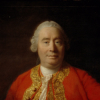
David Hume
David Hume– 25 August 1776) or David Homewas a Scottish philosopher, historian, economist, and essayist, who is best known today for his highly influential system of radical philosophical empiricism, skepticism, and naturalism...
NationalityScottish
ProfessionPhilosopher
Date of Birth7 May 1711
law practice water
The fact that different cultures have different practices no more refutes [moral] objectivism than the fact that water flows in different directions in different places refutes the law of gravity
theologian malady seems
The bigotry of theologians is a malady which seems almost incurable.
air differences fabric
When I shall be dead, the principles of which I am composed will still perform their part in the universe, and will be equally useful in the grand fabric, as when they composed this individual creature. The difference to the whole will be no greater betwixt my being in a chamber and in the open air. The one change is of more importance to me than the other; but not more so to the universe.
race civilization action
I am apt to suspect the Negroes to be naturally inferior to the Whites. There scarcely ever was a civilization of their complexion, nor even any individual, eminent either in action or speculation.
happiness feelings three
Human happiness seems to consist in three ingredients: action, pleasure and indolence.
book eye air
It is with books as with women, where a certain plainness of manner and of dress is more engaging than that glare of paint and airs and apparel which may dazzle the eye, but reaches not the affections.
ideas force vivacity
Apart from the representational content of an idea there is another component: its force and vivacity, its impetus.
science past imagination
We have no other notion of cause and effect, but that of certain objects, which have always conjoin'd together, and which in all past instances have been found inseparable. We cannot penetrate into the reason of the conjunction. We only observe the thing itself, and always find that from the constant conjunction the objects acquire an union in the imagination.
beautiful science fabric
There is nothing, in itself, valuable or despicable, desirable or hateful, beautiful or deformed; but that these attributes arise from the particular constitution and fabric of human sentiment and affection.
stupidity wickedness imbeciles
To philosopher and historian the madness and imbecile wickedness of mankind ought to appear ordinary events.
art kitsch taste
Kitsch is: a species of beauty, which, as it is florid and superficial, pleases at first; but soon palls upon the taste, and is rejected with disdain, at least rated at much lower value.
wise men age
It is harder to avoid censure than to gain applause; for this may be done by one great or wise action in an age. But to escape censure a man must pass his whole life without saying or doing one ill or foolish thing
wise long silence
Nothing is so convenient as a decisive argument ... which must at least silence the most arrogant bigotry and superstition, and free us from their impertinent solicitations. I flatter myself, that I have discovered an argument ... which, if just, will, with the wise and learned, be an everlasting check to all kinds of superstitious delusion, and consequently, will be useful as long as the world endures. For so long, I presume, will the accounts of miracles and prodigies be found in all history, sacred and profane.
passion vanity degrees
Vanity is so closely allied to virtue, and to love the fame of laudable actions approaches so near the love of laudable actions for their own sake, that these passions are more capable of mixture than any other kinds of affection; and it is almost impossible to have the latter without some degree of the former.