Ernst Mayr
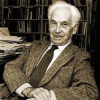
Ernst Mayr
Ernst Walter Mayr was one of the 20th century's leading evolutionary biologists. He was also a renowned taxonomist, tropical explorer, ornithologist, philosopher of biology, and historian of science. His work contributed to the conceptual revolution that led to the modern evolutionary synthesis of Mendelian genetics, systematics, and Darwinian evolution, and to the development of the biological species concept...
NationalityGerman
ProfessionScientist
Date of Birth5 July 1904
CountryGermany
On the other hand, famous evolutionists such as Dobzhansky were firm believers in a personal God. He would work as a scientist all week and then on Sunday get down on his knees and pray to God. Frankly I've never been able to understand it because you would need two totally different compartments in your brain, one that deals with religion and the other with everything else.
Life is simply the reification of the process of living.
The history of science knows scores of instances where an investigator was in the possession of all the important facts for a new theory but simply failed to ask the right questions.
I have the honesty to say I'm an Atheist. There is nothing that supports the idea of a personal God.
Every politician, clergyman, educator, or physician, in short, anyone dealing with human individuals, is bound to make grave mistakes if he ignores these two great truths of population zoology: (1) no two individuals are alike, and (2) both environment and genetic endowment make a contribution to nearly every trait.
No longer is a fixed object transformed, as in transformational evolution, but an entirely new start is, so to speak, made in every generation.
Evolution is no longer necessarily progressive; it no longer strives toward perfection or any other goal. It is opportunistic, hence unpredictable.
On Earth, among millions of lineages or organisms and perhaps 50 billion speciation events, only one led to high intelligence ; this makes me believe its utter improbablity.
I did not claim that every genetic change in a founder population is a genetic revolution. Evidently it requires a special constellation for the occurrence of a more drastic genetic reorganization.
I have been unable to discover in Darwin's writings any connection between allopatric speciation and change of evolutionary rate.
The most consequential change in man's view of the world, of living nature and of himself came with the introduction, over a period of some 100 years beginning only in the 18th century, of the idea of change itself, of change over periods of time: in a word, of evolution.