Franz Kafka
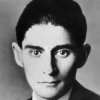
Franz Kafka
Franz Kafkawas a German-language writer of novels and short stories who is widely regarded as one of the major figures of 20th-century literature. His work, which fuses elements of realism and the fantastic, typically features isolated protagonists faced by bizarre or surrealistic predicaments and incomprehensible social-bureaucratic powers, and has been interpreted as exploring themes of alienation, existential anxiety, guilt, and absurdity. His best known works include "Die Verwandlung", Der Process, and Das Schloss. The term Kafkaesque has entered the English...
ProfessionNovelist
Date of Birth3 July 1883
CityPrague, Czech Republic
I am away from home and must always write home, even if any home of mine has long since floated away into eternity.
There's no quiet place here on earth for our love, not in the village and not anywhere else, so I picture a grave, deep and narrow, in which we embrace as if clamped together, I bury my face against you, you yours against me, and no one will ever see us.
Writing is a deeper sleep than death. Just as one wouldn't pull a corpse from its grave, I can't be dragged from my desk at night.
As far as I have seen, at school...they aimed at blotting out one's individuality.
I have the true feeling of myself only when I am unbearably unhappy.
Human nature, essentially changeable, as unstable as the dust, can endure no restraint; if it binds itself it soon begins to tear madly at its bonds, until it rends everything asunder, the wall, the bonds, and its very self.
Life is merely terrible; I feel it as few others do. Often — and in my inmost self perhaps all the time — I doubt whether I am a human being.
I do not read advertisements. I would spend all of my time wanting things.
I never wish to be easily defined.
We live in an age which is so possessed by demons, that soon we shall only be able to do goodness and justice in the deepest secrecy, as if it were a crime.
Everyone carries a room about inside him. This fact can even be proved by means of the sense of hearing. If someone walks fast and one pricks up one’s ears and listens, say in the night, when everything round about is quiet, one hears, for instance, the rattling of a mirror not quite firmly fastened to the wall.
I’m doing badly, I’m doing well; whichever you prefer.
If education tries to make other persons out of us than we essentially are, deeper inside, it stultifies, and reproach matters.
I dream of a grave, deep and narrow, where we could clasp each other in our arms as with clamps, and I would hide my face in you and you would hide your face in me, and nobody would ever see us any more