Galileo Galilei
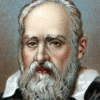
Galileo Galilei
Galileo Galileiwas an Italian astronomer, physicist, engineer, philosopher, and mathematician who played a major role in the scientific revolution of the seventeenth century. He has been called the "father of observational astronomy", the "father of modern physics", and the "father of science". His contributions to observational astronomy include the telescopic confirmation of the phases of Venus, the discovery of the four largest satellites of Jupiter, and the observation and analysis of sunspots. Galileo also worked in applied science and technology,...
NationalityItalian
ProfessionScientist
Date of Birth15 February 1564
CityPisa, Italy
CountryItaly
You cannot teach a man anything; you can only help him discover it in himself.
Nothing can be taught to a man, only it's possibly to help him to discover it inside.
To command the professors of astronomy to confute their own observations is to enjoin an impossibility, for it is to command them not to see what they do see, and not to understand what they do understand, and to find what they do not discover.
The Sun, with all the planets revolving around it, and depending on it, can still ripen a bunch of grapes as though it had nothing else in the Universe to do.
Measure what can be measured, and make measureable what cannot be measured.
For my part I consider the earth very noble and admirable precisely because of the diverse alterations, changes, generations, etc. that occur in it incessantly.
See now the power of truth; the same experiment which at first glance seemed to show one thing, when more carefully examined, assures us of the contrary.
Alas! Your dear friend and servant Galileo has been for the last month hopelessly blind; so that this heaven, this earth, this universe, which I by my marvelous discoveries and clear demonstrations had enlarged a hundred thousand times beyond the belief of the wise men of bygone ages, henceforward for me is shrunk into such a small space as is filled by my own bodily sensations.
One can understand nature only when one has learned the language and the signs in which it speaks to us; but this language is mathematics and these signs are methematical figures.
It was granted to me alone to discover all the new phenomena in the sky and nothing to anybody else. This is the truth which neither envy nor malice can supress.
I do not know what to say in a case so surprising, so unlooked for and so novel.
The number of people that can reason well is much smaller than those that can reason badly. If reasoning were like hauling rocks, then several reasoners might be better than one. But reasoning isn't like hauling rocks, it's like, it's like racing, where a single, galloping Barbary steed easily outruns a hundred wagon-pulling horses.
It has always seemed to me extreme presumptuousness on the part of those who want to make human ability the measure of what nature can and knows how to do, since, when one comes down to it, there is not one effect in nature, no matter how small, that even the most speculative minds can fully understand.
The laws of nature are written by the hand of God in the language of mathematics.