Georges Cuvier
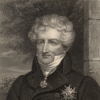
Georges Cuvier
Jean Léopold Nicolas Frédéric Cuvier, known as Georges Cuvier, was a French naturalist and zoologist, sometimes referred to as the "father of paleontology". Cuvier was a major figure in natural sciences research in the early 19th century and was instrumental in establishing the fields of comparative anatomy and paleontology through his work in comparing living animals with fossils...
NationalityFrench
ProfessionScientist
Date of Birth23 August 1769
CountryFrance
land dry body
The appearance of the bones of quadrupeds, especially those of complete bodies in the strata, tells us either that the layer itself which carries them was in earlier times dry land or that dry land was at least formed in the immediate area.
marine animal earth
Secondly, the nature of the revolutions which have altered the surface of the earth must have had a more decisive effect on the terrestrial quadrupeds than on the marine animals.
law harmony aids
It is in this mutual dependence of the functions and the aid which they reciprocally lend one another that are founded the laws which determine the relations of their organs and which possess a necessity equal to that of metaphysical or mathematical laws, since it is evident that the seemly harmony between organs which interact is a necessary condition of existence of the creature to which they belong and that if one of these functions were modified in a manner incompatible with the modifications of the others the creature could no longer continue to exist.
men shoes doubt
A famous anecdote concerning Cuvier involves the tale of his visitation from the devil—only it was not the devil but one of his students dressed up with horns on his head and shoes shaped like cloven hooves. This frightening apparition burst into Cuvier's bedroom when he was fast asleep and claimed: 'Wake up thou man of catastrophes. I am the Devil. I have come to devour you!' Cuvier studied the apparition carefully and critically said, 'I doubt whether you can. You have horns and hooves. You eat only plants.
law doe different
Since nothing can exist that does not fulfil the conditions which render its existence possible, the different parts each being must be co-ordinated in such a way as to render possible the existence of the being as a whole, not only in itself, but also in its relations with other beings, and the analysis of these conditions often leads to general laws which are as certain as those which are derived from calculation or from experiment.
understanding littles fossils
It is my object, in the following work, to travel over ground which has as yet been little explored and to make my reader acquainted with a species of Remains, which, though absolutely necessary for understanding the history of the globe, have been hitherto almost uniformly neglected.
animal together form
All organs of an animal form a single system, the parts of which hang together, and act and re-act upon one another; and no modifications can appear in one part without bringing about corresponding modifications in all the rest.
force observation observers
The observer listens to nature: the experimenter questions and forces her to reveal herself.
animal people three
Moreover, it thus follows that not a great deal of time was needed for the large animals of the three major parts of the world to become known to the people who spent time on the coasts of those regions.
men darkness revolution
If they [enlightened men] take any interest in examining, in the infancy of our species, the almost obliterated traces of so many nations that have become extinct, they will doubtless take a similar interest in collecting, amidst the darkness which covers the infancy of the globe, the traces of those revolutions which took place anterior to the existence of all nations.
art honor ornithology
[Audubon's works are] the most splendid monuments which art has erected in honor of ornithology.
animal land earth
My object will be, first, to show by what connections the history of the fossil bones of land animals is linked to the theory of the earth and why they have a particular importance in this respect.
mean passion past
It has been long considered possible to explain the more ancient revolutions on... the Earth surface by means of these still existing causes; in the same manner as it is found easy to explain past events in political history, by an acquaintance with the passions and intrigues of the present day. But we shall presently see that unfortunately this is not the case in physical history:-the thread of operation is here broken, the march of nature is changed, and none of the agents that she now employs were sufficient for the production of her ancient works.
men race space
Genius and science have burst the limits of space, and few observations, explained by just reasoning, have unveiled the mechanism of the universe. Would it not also be glorious for man to burst the limits of time, and, by a few observations, to ascertain the history of this world, and the series of events which preceded the birth of the human race?