Herbert Marcuse
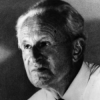
Herbert Marcuse
Herbert Marcusewas a German-American philosopher, sociologist, and political theorist, associated with the Frankfurt School of Critical Theory. Born in Berlin, Marcuse studied at the universities of Berlin and then at Freiburg, where he received his Ph.D. He was a prominent figure in the Frankfurt-based Institute for Social Research – what later became known as the Frankfurt School. He was married to Sophie Wertheim, Inge Neumann, and Erica Sherover. In his written works, he criticized capitalism, modern technology, historical materialism and...
NationalityGerman
ProfessionPhilosopher
Date of Birth18 July 1898
CountryGermany
Herbert Marcuse quotes about
Dialectical logic undoes the abstractions of formal logic and of transcendental philosophy, but it also denies the concreteness of immediate experience. To the extent to which this experience comes to rest with the things as they appear and happen to be, it is a limited and even false experience. It attains its truth if it has freed itself from the deceptive objectivity which conceals the factors behind the facts that is, if it understands its world as a historical universe, in which the established facts are the work of the historical practice of man.
The judgment that human life is worth living, or rather can and ought to be made worth living, ... underlies all intellectual effort; it is the a priori of social theory, and its rejection (which is perfectly logical) rejects theory itself.
Institutionalized desublimation thus appears to be an aspect of the "conquest of transcendence" achieved by the one-dimensional society. Just as this society tends to reduce, and even absorb opposition (the qualitative difference!) in the realm of politics and higher culture, so it does in the instinctual sphere. The result is the atrophy of the mental organs for grasping the contradictions and the alternatives and, in the one remaining dimension of technological rationality, the Happy Consciousness comes to prevail.
the society which projects and undertakes the technological transformation of nature alters the base of domination by gradually replacing personal dependence (of the slave on the master, the serf on the lord of the manor, the lord on the donor of the fief, etc.) with dependence on the "objective order of things" (on economic laws, the market etc.).
Coming to life as classics, they come to life as other than themselves; they are deprived of their antagonistic force, of the estrangement which was the very dimension of their truth.
The philosopher ... subjects experience to his critical judgment, and this contains a value judgment namely, that freedom from toil is preferable to toil, and an intelligent life is preferable to a stupid life. It so happened that philosophy was born with these values. Scientific thought had to break this union of value judgment and analysis, for it became increasingly clear that the philosophic values did not guide the organisation of society.
If man has learned to see and know what really is, he will act in accordance with truth, Epistemology is in itself ethics, and ethics is epistemology.
The societal division of labor obtains the dignity of an ontological condition.
Thought and speech are of a thinking and speaking subject, and if the life of the latter depends on the performance of a superimposed function, it depends on fulfilling the requirements of this function thus it depends on those who control these requirements.
The closed language does not demonstrate and explain it communicates decision, dictum, command. Where it defines, the definition becomes "separation of good from evil;" it establishes unquestionable
Those who devote their lives to earning a living are incapable of living a human existence.
Domination has its own aesthetics, and democratic domination has its democratic aesthetics.
The range of socially permissible and desirable satisfaction is greatly enlarged, but through this satisfaction, the Pleasure Principle is reduced deprived of the claims which are irreconcilable with the established society. Pleasure, thus adjusted, generates submission.
The ontological concept of truth is in the centre of a logic which may serve as a model of pre- technological rationality. It is the rationality of a two-dimensional universe of discourse which, contrasts with the of thought and behavior that develop in the execution of the technological project.