Hermann Weyl
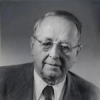
Hermann Weyl
Hermann Klaus Hugo Weyl, ForMemRSwas a German mathematician, theoretical physicist and philosopher. Although much of his working life was spent in Zürich, Switzerland and then Princeton, he is associated with the University of Göttingen tradition of mathematics, represented by David Hilbert and Hermann Minkowski. His research has had major significance for theoretical physics as well as purely mathematical disciplines including number theory. He was one of the most influential mathematicians of the twentieth century, and an important member of the...
NationalityGerman
ProfessionMathematician
Date of Birth9 November 1885
CountryGermany
You can not apply mathematics as long as words still becloud reality.
But it seems an irony of creation that man's mind knows how to handle things the better the farther removed they are from the center of his existence. Thus we are cleverest where knowledge matters least....
Our mathematics of the last few decades has wallowed in generalities and formalizations.
Before you generalize, formalize, and axiomatize there must be mathematical substance.
The question for the ultimate foundations and the ultimate meaning of mathematics remains open; we do not know in which direction it will find its final solution nor even whether a final objective answer can be expected at all. "Mathematizing" may well be a creative activity of man, like language or music, of primary originality, whose historical decisions defy complete objective rationalization.
Not only in geometry, but to a still more astonishing degree in physics, has it become more and more evident that as soon as we have succeeded in unraveling fully the natural laws which govern reality, we find them to be expressible by mathematical relations of surprising simplicity and architectonic perfection. It seems to me to be one of the chief objects of mathematical instruction to develop the faculty of perceiving this simplicity and harmony.
Besides language and music, mathematics is one of the primary manifestations of the free creative power of the human mind.
God exists because arithmetic is consistent - the Devil exists because we can't prove it!
Mathematics is not the rigid and rigidity-producing schema that the layman thinks it is; rather, in it we find ourselves at that meeting point of constraint and freedom that is the very essence of human nature.
Logic is the hygiene the mathematician practices to keep his ideas healthy and strong.
Besides language and music, it [mathematics] is one of the primary manifestations of the free creative power of the human mind, and it is the universal organ for world understanding through theoretical construction. Mathematics must therefore remain an essential element of the knowledge and abilities which we have to teach, of the culture we have to transmit, to the next generation.
It is impossible to discuss realism in logic without drawing in the empirical sciences... A truly realistic mathematics should be conceived, in line with physics, as a branch of the theoretical construction of the one real world and should adopt the same sober and cautious attitude toward hypothetic extensions of its foundation as is exhibited by physics.
For mathematics, even to the logical forms in which it moves, is entirely dependent on the concept of natural number.
One may say that mathematics talks about the things which are of no concern to men. Mathematics has the inhuman quality of starlight - brilliant, sharp but cold ... thus we are clearest where knowledge matters least: in mathematics, especially number theory.