Immanuel Kant
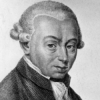
Immanuel Kant
Immanuel Kantwas a German philosopher who is considered the central figure of modern philosophy. Kant argued that fundamental concepts of the human mind structure human experience, that reason is the source of morality, that aesthetics arises from a faculty of disinterested judgment, that space and time are forms of our sensibility, and that the world as it is "in-itself" is unknowable. Kant took himself to have effected a Copernican revolution in philosophy, akin to Copernicus' reversal of the age-old belief...
NationalityGerman
ProfessionPhilosopher
Date of Birth22 April 1724
CountryGermany
Freedom is the alone unoriginated birthright of man, and belongs to him by force of his humanity; and is independence on the will and co-action of every other in so far as this consists with every other person's freedom.
There is a limit where the intellect fails and breaks down, and this limit is where the questions concerning God and freewill and immortality arise.
If justice perishes, human life on Earth has lost its meaning.
***Three Conditions of Happiness*** If you have work to do If you have someone you love If You have hope Then You are Happy now!
If education is to develop human nature so that it may attain the object of its being, it must involve the exercise of judgment.
It is often necessary to make a decision on the basis of knowledge sufficient for action but insufficient to satisfy the intellect.
But where only a free play of our presentational powers is to be sustained as in the case of pleasure gardens, room decoration, all sorts of useful utensils, and so on, any regularity that has an air of constraint is to be avoided as much as possible. That is why the English taste in gardens, or the baroque taste in furniture, carries the imagination's freedom very far, even to the verge of the grotesque, because it is precisely this divorce from any constraint of a rule that the case is posited where taste can show its greatest perfection in designs made by the imagination.
If a man is often the subject of conversation he soon becomes the subject of criticism.
Procrastination is hardly more evil than grasping impatience.
Is it reasonable to assume a purposiveness in all the parts of nature and to deny it to the whole?
One who makes himself a worm cannot complain afterwards if people step on him.
The existence of the Bible is the greatest blessing which humanity ever experienced.
There is no virtue in penance and fasting which waste the body; they are only fanatical and monkish.
The science of mathematics presents the most brilliant example of how pure reason may successfully enlarge its domain without the aid of experience