J. Robert Oppenheimer
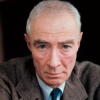
J. Robert Oppenheimer
Julius Robert Oppenheimerwas an American theoretical physicist and professor of physics at the University of California, Berkeley. As the wartime head of the Los Alamos Laboratory, Oppenheimer is among those who are called the "father of the atomic bomb" for their role in the Manhattan Project, the World War II project that developed the first nuclear weapons used in the atomic bombings of Hiroshima and Nagasaki. The first atomic bomb was detonated on July 16, 1945, in the Trinity test...
NationalityAmerican
ProfessionPhysicist
Date of Birth22 April 1904
CountryUnited States of America
Maybe General Groves was right. Maybe we should just banish thinking forever.
I can't think that it would be terrible of me to say — and it is occasionally true — that I need physics more than friends.
All history teaches us that these questions that we think the pressing ones will be transmuted before they are answered, that they will be replaced by others, and that the very process of discovery will shatter the concepts that we today use to describe our puzzlement.
Optimists think that this is the best of all possible worlds; pessimists fear they are right.
There must be no barriers to freedom of inquiry. There is no place for dogma in science. The scientist is free, and must be free to ask any question, to doubt any assertion, to seek for any evidence, to correct any errors. ... Our political life is also predicated on openness. We know that the only way to avoid error is to detect it and that the only way to detect it is to be free to inquire. And we know that as long as men are free to ask what they must, free to say what they think, free to think what they will, freedom can never be lost, and science can never regress.
We knew the world would not be the same.
I'll never forget his walk; I'll never forget the way he stepped out of the car.... This kind of strut. He had done it.
To try to be happy is to try to build a machine with no other specification than that it shall run noiselessly.
The powerful notion of entropy, which comes from a very special branch of physics … is certainly useful in the study of communication and quite helpful when applied in the theory of language.
We know that the wages of secrecy are corruption. We know that in secrecy, error undetected will flourish and subvert.
It is proper to the role of the scientist that he not merely find new truth and communicate it to his fellows, but that he teach, that he try to bring the most honest and intelligible account of new knowledge to all who will try to learn.
This is a world in which each of us, knowing his limitations, knowing the evils of superficiality and the terrors of fatigue, will have to cling to what is close to him, to what he knows, to what he can do. . .
This world of ours is a new world, in which the unit of knowledge, the nature of human communities, the order of society, the order of ideas, the very notions of society and culture have changed, and will not return to what they have been in the past. What is new is new, not because it has never been there before, but because it has changed in quality.
I need physics more than friends.