James Bryant Conant
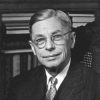
James Bryant Conant
James Bryant Conantwas an American chemist, a transformative President of Harvard University, and the first U.S. Ambassador to West Germany. Conant obtained a PhD in Chemistry from Harvard in 1916. During World War I he served in the U.S. Army, working on the development of poison gases. He became an assistant professor of chemistry at Harvard in 1919, and the Sheldon Emery Professor of Organic Chemistry in 1929. He researched the physical structures of natural products, particularly chlorophyll, and he...
NationalityAmerican
ProfessionScientist
Date of Birth26 March 1893
CountryUnited States of America
James Bryant Conant quotes about
Behavior which appears superficially correct but is intrinsically corrupt always irritates those who see below the surface.
A Harvard education consists of what you learn at Harvard while you are not studying.
Education is what is left after all that has been learnt is forgotten.
The stumbling way in which even the ablest of the scientists in every generation have had to fight through thickets of erroneous observations, misleading generalizations, inadequate formulation, and unconscious prejudice is rarely appreciated by those who obtain their scientific knowledge from textbooks.
I venture to define science as a series of interconnected concepts and conceptual schemes arising from experiment and observation and fruitful of further experiments and observations. The test of a scientific theory is, I suggest, its fruitfulness.
Just like a turtle, we only make progress if we stick our neck out.
Behold the turtle. He makes progress only when he sticks his neck out.
Science emerges from the other progressive activities of man to the extent that new concepts arise from experiments and observations, and that the new concepts in turn lead to further experiments and observations.
The dignity of man is vindicated as much by the thinker and poet as by the statesman and soldier.
There is only one proved method of assisting the advancement of pure science-that of picking men of genius, backing them heavily, and leaving them to direct themselves.
In every section of the entire area where the word science may properly be applied, the limiting factor is a human one. We shall have rapid or slow advance in this direction or in that depending on the number of really first-class men who are engaged in the work in question. ... So in the last analysis, the future of science in this country will be determined by our basic educational policy.
Whether a man lives or dies in vain can be measured only by the way he faces his own problems, by the success or failure of the inner conflict within his own soul. And of this no one may know save God.