James D. Watson
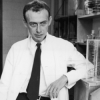
James D. Watson
James Dewey Watsonis an American molecular biologist, geneticist and zoologist, best known as one of the co-discoverers of the structure of DNA in 1953 with Francis Crick. Watson, Crick, and Maurice Wilkins were awarded the 1962 Nobel Prize in Physiology or Medicine "for their discoveries concerning the molecular structure of nucleic acids and its significance for information transfer in living material"...
NationalityAmerican
ProfessionScientist
Date of Birth6 April 1928
CountryUnited States of America
I don't want to die until I see cancer cured.
It is extraordinary the extent to which Darwin's insights not only changed his contemporaries' view of the world but also continue to be a source of great intellectual stimulation for scientists and nonscientists alike.
My whole life has been basically trying to find intelligent students or, you know, highly motivated students and giving them an opportunity to do good science.
I first became aware of Charles Darwin and evolution while still a schoolboy growing up in Chicago. My father and I had a passion for bird-watching, and when the snow or the rain kept me indoors, I read his bird books and learned about evolution.
I've had strong opinions probably since I was born. It makes you unpopular, but what can you do?
I would only once have the opportunity to let my scientific career encompass a path from the double helix to the three billion steps of the human genome.
Spotting a rare bird is never worth the bite of a cur. Once bitten by a German shepherd, I knew that I preferred cats, even if they are bird-killers. Life is long enough for more than one chance at a rare bird.
As a child, I lived with being punier than other boys in class. The only consolation was my parents' empathy - they encouraged constant trips to the local drugstore for chocolate milk shakes to fatten me up. The shakes made me happy, but still, all through grammar school, other kids shoved me around.
If you accept that people are the products of evolution, then you have to have an open mind to the truth. Unfair discrimination exists whether we like it or not; I wouldn't have married a gum-chewing vegetarian.
We should govern our actions by assuming that people are more good than bad. Whereas, most of our social policies dictate that people are more bad than good. That you know if you do something, it'll be seized by the rich to exploit the poor.
Here at the Cold Spring Harbor Laboratory, we have genetically rearranged various viruses and bacteria as part of our medical research. In fact, we have been able to create entirely new types of DNA molecules by splicing together the genetic information from different organisms - recombinant DNA.
I was always very curious about what a scientist's life was like when I was young. Of course, when I was young, you didn't have very many opportunities to find out with no web, TV. I was very lucky: I was born in the city of Chicago and went to the University of Chicago where I actually saw things.
If someone's liver doesn't work, we blame it on the genes; if someone's brain doesn't work properly, we blame the school. It's actually more humane to think of the condition as genetic. For instance, you don't want to say that someone is born unpleasant, but sometimes that might be true.
I don't want 100 different cures of cancer. I want, you know, give me five. So if you had, you know, five medicines, you could do away with 90 percent of cancer. That's sort of my objective. I think we're going to do it.