Jean Piaget
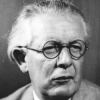
Jean Piaget
Jean Piagetwas a Swiss clinical psychologist known for his pioneering work in child development. Piaget's theory of cognitive development and epistemological view are together called "genetic epistemology"...
NationalitySwiss
ProfessionScientist
Date of Birth9 August 1896
CityNeuchatel, Switzerland
CountrySwitzerland
becomes begins capable child objective practical purely recall starting subjective
We recall how, starting with purely practical and quasi-physiological groups, the child begins by elaborating subjective groups, then arrives at objective groups, and only then becomes capable of representative groups.
religious children unique
There is little mysticism without an element of transcendence, and conversely, there is no transcendence without a certain degree of egocentrism. It may be that the genesis of these experiences is to be sought in the unique situation of the very young child in relation to adults. The theory of the filial origin of the religious sense seems to us singularly convincing in this connection.
children believe giving
The majority of parents are poor psychologists and give their children the most questionable moral trainings. It is perhaps in this domain that one realized most how keenly how immoral it can be to believe too much in morality, and how much more precious is a little humanity than all the rules in the world.
children eye long
It is as his own mind comes into contact with others that truth will begin to acquire value in the child's eyes and will consequently become a moral demand that can be made upon him. As long as the child remains egocentric, truth as such will fail to interest him and he will see no harm in transposing facts in accordance with his desires.
children stress elements
The child is a realist in every domain of thought, and it is therefore natural that in the moral sphere he should lay more stress on the external, tangible element than on the hidden motive.
children sacrifice self
The relations between parents and children are certainly not only those of constraint. There is spontaneous mutual affection, which from the first prompts the child to acts of generosity and even of self-sacrifice, to very touching demonstrations which are in no way prescribed. And here no doubt is the starting point for that morality of good which we shall see developing alongside of the morality of right or duty, and which in some persons completely replaces it.
children balance looks
Mixture of assimilation to earlier schemas and adaptation to the actual conditions of the situation is what defines motor intelligence. But and this is where rules come into existence as soon as a balance is established between adaptation and assimilation, the course of conduct adopted becomes crystallized and ritualized. New schemas are even established which the child looks for and retains with care, as though they were obligatory or charged with efficacy.
children lying naughty
The child who defines a lie as being a "naughty word" knows perfectly well that lying consists in not speaking the truth. He is not, therefore, mistaking one thing for another, he is simply identifying them one with another by what seems to us a quaint extension of the word "lie".
children attitude intellectual
In certain circumstances where he experiments in new types of conduct by cooperating with his equals, the child is already an adult. There is an adult in every child and a child in every adult. ... There exist in the child certain attitudes and beliefs which intellectual development will more and more tend to eliminate: there are others which will acquire more and more importance. The later are not derived from the former but are partly antagonistic to them.
children teach inventing
Everytime we teach a child something, we prevent him from inventing it himself.
inspirational education children
It is with children that we have the best chance of studying the development of logical knowledge, mathematical knowledge, physical knowledge, and so forth.
children reality action
During the earliest stages the child perceives things like a solipsist who is unaware of himself as subject and is familiar only with his own actions.
children understanding teach
Each time one prematurely teaches a child something he could have discovered himself, that child is kept from inventing it and consequently from understanding it completely.
children interesting mind
How can we, with our adult minds, know what will be interesting? If you follow the child...you can find out something new...