Jiddu Krishnamurti
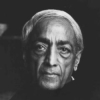
Jiddu Krishnamurti
Jiddu Krishnamurtiwas a speaker and writer on matters that concerned humankind. In his early life he was groomed to be the new World Teacher but later rejected this mantle and withdrew from the organization behind it. His subject matter included psychological revolution, the nature of mind, meditation, inquiry, human relationships, and bringing about radical change in society. He constantly stressed the need for a revolution in the psyche of every human being and emphasised that such revolution cannot be brought...
NationalityIndian
ProfessionPhilosopher
Date of Birth12 May 1895
CountryIndia
Jiddu Krishnamurti quotes about
As long as the mind is in conflict-blaming, resisting, condemning-there can be no understanding. If I want to understand you, I must not condemn you, obviously.
As long as the mind is seeking to fill itself, it will always be empty. When the mind is no longer concerned with filling its own emptiness, then only does that emptiness cease to be.
As long as you are held within a pattern you must create disorder in the world.
We need tremendous energy to bring about a psychological change in ourselves as human beings, because we have lived far too long in a world of make-belief, in a world of brutality, violence, despair, anxiety. To live humanly, sanely, one has to change.
Tradition, long conditioned thinking, can bring about a fixation, a concept that one readily accepts, perhaps not with a great deal of thought.
Love is a state of being, and in that state, the 'me', with its identifications, anxieties, and possessions is absent. Love cannot be, as long as the activities of the self, of the 'me', whether conscious or unconscious, continue to exist.
As long as the mind clings to belief, it is held in a prison.
As long as you ask questions you are breaking through, but the moment you begin to accept, you are psychologically dead. So right through life don't accept a thing, but inquire, investigate. Then you will find that your mind is something really extraordinary, it has no end, and to such a mind there is no death.
Living is not this tawdry, mediocre, disciplined thing which we call our existence. Living is something entirely different; it is abundantly rich, timelessly changing, and as long as we don't understand that eternal movement, our lives are bound to have very little meaning.
There is no need to education. It is not that you read a book, pass an examination, and finish with education. The whole of life, from the moment you are born to the moment you die, is a process of learning.
Learning is the very essence of humility . . .
You can only hear clearly when you sit quietly, when you give your attention. Nor can you have order if you are not free to watch, if you are not free to listen, if you are not free to be considerate. This problem of freedom and order is one of the most difficult and urgent problems in life. It is a very complex problem. It needs to be thought over much more than mathematics, geography, or history.
Some go to sleep in an organization and never wake up, and those who do wake up put them selves to sleep again by joining another. This acquisitive movement is called expansion of thought, progress.
Only when the mind is tranquil-through self-knowledge and not through imposed self-discipline-only then, in that tranquillity, in that silence, can reality come into being. It is only then that there can be bliss, that there can be creative action.