John Dos Passos
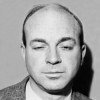
John Dos Passos
John Roderigo Dos Passoswas an American novelist and artist active in the first half of the twentieth century. Born in Chicago, Illinois, he graduated from Harvard College in 1916. He was well-traveled, visiting Europe and the Middle East, where he learned about literature, art, and architecture. During World War I he was a member of the American Volunteer Motor Ambulance Corps in Paris and in Italy, later joining the U.S. Army Medical Corps...
NationalityAmerican
ProfessionNovelist
Date of Birth14 January 1896
CountryUnited States of America
If there is a special Hell for writers it would be in the forced contemplation of their own works.
Accidents will happen in the best regulated families.
We work to eat to get the strength to work to eat to get the strength to work to eat to get the strength to work to eat to get the strength to work.
What is the use being a big man if you are wrong?
Women alone always order sole. It means something.
Shakespeare wouldn't have been any good if he'd stayed in Stratford. He had to go to London to be bathed in the full current of the Renaissance.
Sex is a slotmachine.
The chilly December day! two shivering bicycle mechanics from Dayton, Ohio first felt their homemade contraption whittled out of hickory sticks, gummed together with Arnstein's bicycle cement, stretched with muslin they'd sewn on their sister's sewing machine in their own backyard on Hawthorn Street in Dayton, Ohio, soar into the air above the dunes and the wide beach at Kitty Hawk.
Men who have lost their conviction of what is good and what is bad find themselves without a sextant to check their position by. We are in the position of a man with an elaborate camping kit who finds himself lost in the woods without his matches; to kindle a fire he has to resort to the stratagems of the caveman. We fall back through generations into the oldest terrors and confusions of the race.
There is a part of me in every character, naturally. That's why novelists rarely write good autobiographies. You start one and it becomes another novel.
Breaking with old friends is one of the most painful of the changes in all that piling up of a multitude of small distasteful changes that constitutes growing older.
The only excuse for a novelist, aside from the entertainment and vicarious living his books give the people who read them, is as a sort of second-class historian of the age he lives in. The "reality" he missed by writing about imaginary people, he gains by being able to build a reality more nearly out of his own factual experience than a plain historian or biographer can.
The business of a novelist is, in my opinion, to create characters first and foremost, and then to set them in the snarl of the human currents of his time, so that there results an accurate permanent record of a phase of history.
One of the most extraordinary things about industrial society of the present day is its idiot lack of memory. Tabloids and movies take the place of mental processes and revolts, crimes, despairs pass off in a dribble of vague words and rubber stamp phrases without leaving a scratch on the mind of the driven instalment-paying, subway-packing mass.