Jonas Salk
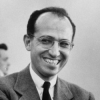
Jonas Salk
Jonas Edward Salkwas an American medical researcher and virologist. He discovered and developed the first successful polio vaccine. Born in New York City, he attended New York University School of Medicine, later choosing to do medical research instead of becoming a practicing physician. In 1939, after earning his medical degree, Salk began an internship as a scientist physician at Mount Sinai Hospital. Two years later he was granted a fellowship at the University of Michigan, where he would study flu...
NationalityAmerican
ProfessionScientist
Date of Birth28 October 1914
CountryUnited States of America
What you see in living systems, and in genetic systems, is that the genes are already there, having arisen in the course of time, and when they are needed they become activated. If they had to be invented, the time would be too late.
I overcame the nightmares because of my dreams.
One of the greatest rewards for doing can be the chances it gives to do some more - even better.
I have the impression that the new generation of young people, are coming up on the scene with a sense "ancestorhood", and with more wisdom than was evident before.
My job is to help people see what I see. If it's of value, fine. And, if it's not of value, then at least I've done what I can do.
When I worked on the polio vaccine, I had a theory. I guided each [experiment] by imagining myself in the phenomenon in which I was interested. The intuitive realm . . . the realm of the imagination guides my thinking.
A wisdom deficit - fewer elders and even fewer people who listen to them.
Solutions come through evolution. They come through asking the right questions, because the answers pre-exist. It is the questions that we must define and discover. You don't invent the answer-you reveal the answer.
Evolution favors the survival of the wisest.
You can have a team of unconventional thinkers, as well as conventional thinkers. If you don't have the support of others you cannot achieve anything altogether on your own. It's like a cry in the wilderness. In each instance there were others who could see the same thing, and there were others who could not. It's an obvious difference we see in those who you might say have a bird's eye view, and those who have a worm's eye view. I've come to realize that we all have a different mind set, we all see things differently, and that's what the human condition is really all about.
When things get bad enough, then something happens to correct the course. And it's for that reason that I speak about evolution as an error-making and an error-correcting process. And if we can be ever so much better - ever so much slightly better - at error correcting than at error making, then we'll make it.
I think of the need for more wisdom in the world, to deal with the knowledge that we have. At one time we had wisdom, but little knowledge. Now we have a great deal of knowledge, but do we have enough wisdom to deal with that knowledge?
The worst tragedy that could have befallen me was my success. I knew right away that I was through - cast out.
I'm saying that we should trust our intuition. I believe that the principles of universal evolution are revealed to us through intuition. And I think that if we combine our intuition and our reason, we can respond in an evolutionary sound way to our problems.