Karl Popper
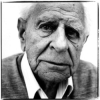
Karl Popper
Sir Karl Raimund Popper CH FBA FRSwas an Austrian-British philosopher and professor. He is generally regarded as one of the greatest philosophers of science of the 20th century...
NationalityAustrian
ProfessionPhilosopher
Date of Birth28 July 1902
CountryAustria
mistake believe choices
Psychologism is, I believe, correct only in so far as it insists upon what may be called 'methodological individualism' as opposed to 'methodological collectivism'; it rightly insists that the 'behaviour' and the 'actions' of collectives, such as states or social groups, must be reduced to the behaviour and to the actions of human individuals. But the belief that the choice of such an individualist method implies the choice of a psychological method is mistaken.
giving-up mean science
Is the world ruled by strict laws or not? This question I regard as metaphysical. The laws we find are always hypotheses; which means that they may always be superseded, and that they may possibly be deduced from probability estimates. Yet denying causality would be the same as attempting to persuade the theorist to give up his search; and that such an attempt cannot be backed by anything like a proof...
science way scientific-method
It is the rule which says that the other rules of scientific procedure must be designed in such a way that they do not protect any statement in science against falsification.
science reality ideas
But some of these theories are so bold that they can clash with reality: they are the testable theories of science. And when they clash, then we know that there is a reality; something that can inform us that our ideas are mistaken.
taken law forever
[The aim of science is] to explain what so far has taken to be an explicans, such as a law of nature. The task of empirical science constantly renews itself. We may go on forever, proceeding to explanations of a higher and higher universality...
attitude believe successful
A system such as classical mechanics may be 'scientific' to any degree you like; but those who uphold it dogmatically - believing, perhaps, that it is their business to defend such a successful system against criticism as long as it is not conclusively disproved - are adopting the very reverse of that critical attitude which in my view is the proper one for the scientist.
religious powerful war
The Conspiracy Theory of Society... [is] a typical result of the secularization of a religious superstition. The belief in the Homeric gods whose conspiracies explain the history of the Trojan War is gone. The gods are abandoned. But their place is filled by powerful men or groups - sinister pressure groups whose wickedness is responsible for all the evils we suffer from - such as the Learned Elders of Zion, or the monopolists, or the capitalists, or the imperialists.
truth principles logical
Now this principle of induction cannot be a purely logical truth like a tautology or an analytic statement. . . .
temptation promise lure
The future is always present, as a promise, a lure and a temptation.
law belief natural
Our belief in any particular natural law cannot have a safer basis than our unsuccessful critical attempts to refute it.
experience
It must be possible for an empirical system to be refuted by experience.
science views ease
It is not intuitive ease I am after, but rather a point of view which is sufficiently definite to clear up some difficulties, and to be criticized in rational terms. (Bohr's complementarity cannot be so criticized, I fear; it can only be accepted or denounced - perhaps as being ad hoc, or as being irrational, or as being hopelessly vague.)
order might able
Astrologers were greatly impressed, and misled, by what they believed to be confirming evidence-so much so that they were quite unimpressed by any unfavorable evidence. Moreover, by making their interpretations and prophecies sufficiently vague they were able to explain away anything that might have been a refutation of the theory had the theory and the prophecies been more precise. In order to escape falsification they destroyed the testability of their theory. It is a typical soothsayer's trick to predict things so vaguely that the predictions can hardly fail: that they become irrefutable.
people giving democracy
It is wrong and dangerous to extol freedom by telling people that they will certainly be all right once they are free. ... The most we can say of democracy or freedom is that they give our personal abilities a little more influence on our well-being.