Kiki Smith
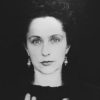
Kiki Smith
Kiki Smithis a West German-born American artist whose work has addressed the themes of sex, birth and regeneration. Her figurative work of the late 1980s and early 1990s confronted subjects such as AIDS, gender and race, while recent works have depicted the human condition in relationship to nature. Smith lives and works in the Lower East Side neighborhood of New York City...
NationalityAmerican
ProfessionSculptor
Date of Birth18 January 1954
CityNuremberg, Germany
CountryUnited States of America
I trust my work. It's a collaboration with the material, and when it's viewed, it's a collaboration with the world.
Artists live in unknown spaces and give themselves over to following something unknown.
Our culture seems to believe that it's entertaining to teach women to be frightened.
One hopes that each piece contains enough space for several narratives.
Prints mimic what we are as humans: we are all the same and yet every one is different. I think there's a spiritual power in repetition, a devotional quality, like saying rosaries.
I told the students [at Yale] we were going to talk about love - I meant love in the sense of devotions to one's work - and about half the students got really pissed off.
Making art is a lot about just seeing what happens if you put some energy into something.
I think that sense of always traveling has something to do with anonymity and privacy and pleasure in having a very clear, very reductive life.
One's self is always shifting in relationship to beauty and you always have to be able to incorporate yourself or your new self into life. Like your skin starts hanging off your arms and stuff, and then you have to think, well that's really beautiful too. It just isn't beautiful in a way that I knew it was beautiful before.
I think making things beautiful is important. But often what's first considered ugly is beautiful, too.
It’s one of my loose theories that Catholicism and art have gone well together because both believe in the physical manifestation of the spiritual world.
You can have fantasies about having control over the world, but I know I can barely control my kitchen sink. That is the grace I'm given. Because when one can control things, one is limited to one's own vision.
The point isn't to know what you're doing. The point is to have an experience doing something.
I like that feeling when you’re making art, that you’re taking the energy out of your body and putting it into a physical object. I like things that are labor-intensive : you make a little thing and another little thing and another little thing, and eventually you see a possibility.