Lawrence Lessig
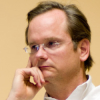
Lawrence Lessig
Lester Lawrence "Larry" Lessig IIIis an American academic, attorney, and political activist. He is the Roy L. Furman Professor of Law at Harvard Law School and the former director of the Edmond J. Safra Center for Ethics at Harvard University. Lessig was a candidate for the Democratic Party's nomination for President of the United States in the 2016 U.S. presidential election, but withdrew before the primaries...
NationalityAmerican
ProfessionEntrepreneur
Date of Birth3 June 1961
CountryUnited States of America
Americans have been selling this view around the world: that progress comes from perfect protection of intellectual property.
Believing we know what makes prosperity work, ignoring the nature of the actual prosperity all around, we change the rules within which the Internet revolution lives. These changes will end the revolution.
By the time Apple's Macintosh operating system finally falls into the public domain, there will be no machine that could possibly run it. The term of copyright for software is effectively unlimited.
A world where Congressmen spend 30 to 70 percent of their time raising money from a tiny, tiny fraction of the 1% is a world where that tiny, tiny fraction has enormous power. And it's that inequality in political power that enables this corrupted system to happen.
If the only way a library can offer an Internet exhibit about the New Deal is to hire a lawyer to clear the rights to every image and sound, then the copyright system is burdening creativity in a way that has never been seen before because there are no formalities.
When government disappears, its not as if paradise will take its place. When governments are gone, other interests will take their place.
All of the great Disney works took works that were in the public domain and remixed them.
If zero percent of the elites support something, very low chance it's going to pass, if 100% support something, very high chance it's going to pass. Same thing for organized interest groups. But for the average voter, it's a flat line. Which says it doesn't matter whether zero percent of the public believes something or 100% of the average voters believe something - it doesn't affect the probability that that thing will be enacted.
Of all the creative work produced by humans anywhere, a tiny fraction has continuing commercial value. For that tiny fraction, the copyright is a crucially important legal device.
[Conservatives] go to church, they do lots of things for free for each other. They hold potluck dinners. ... They serve food to poor people. They share, they give, they give away for free. It's the very same people leading Wall Street firms who, on Sundays, show up and share.
There is a culture among academics to be obscure. If you're too clear, you can't be saying anything interesting. The issue isn't word length. The issue is a commitment to speaking in a way an audience can understand.
Power runs with ideas that only the crazy would draw into doubt.
Some blame the drug companies. I don't. They are corporations. Their managers are ordered by law to make money for the corporation. They push a certain patent policy not because of ideals,but because it is the policy that makes them the most money. And it only makes them the most money because of a certain corruption within our political system-a corruption the drug companies are certainly not responsible for. The corruption is our own politicians' failure of integrity.
For however much the state may gain by not having to fund roads on its own, society would lose in aggregate if the open commons of transportation were lost.